Published: 24 Jul 2026
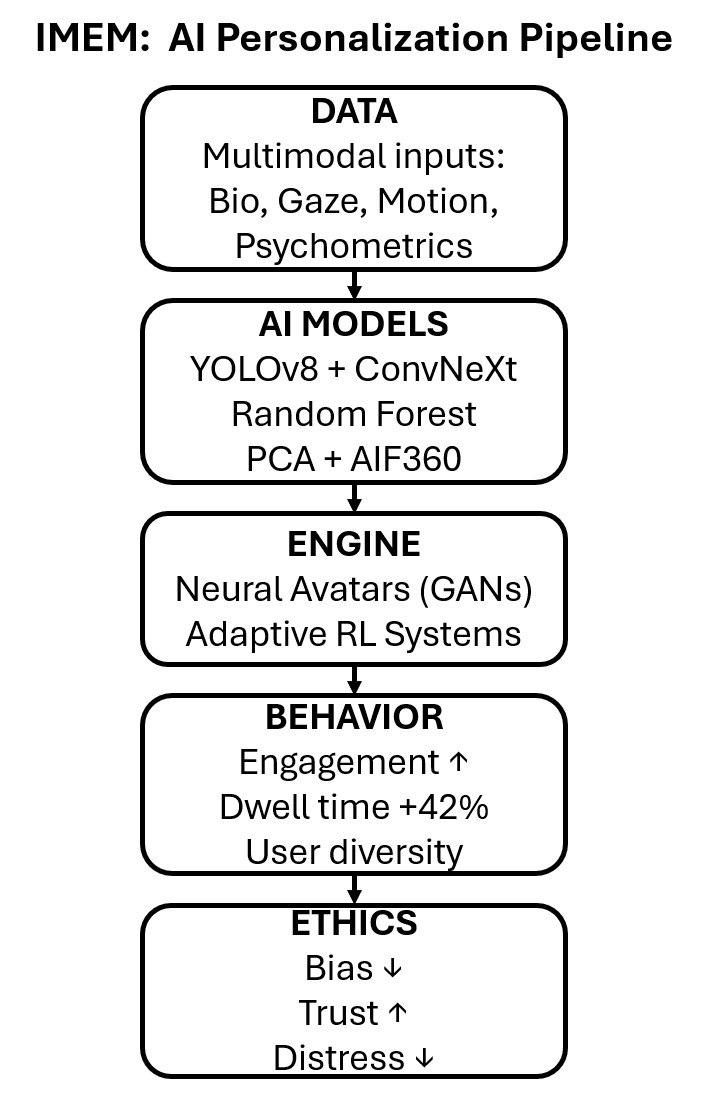
Neural Avatars and Adaptive Systems: Behavioral Dynamics and Ethical Governance in the Metaverse
Volume 3
Subscribe for research updates and exclusive content straight to your inbox
Published: 24 Jul 2026
Volume 3
Gabriel Silva-Atencio
gsilvaa468@ulacit.ed.cr
Published: 15 Jul 2026
Volume 3
Gabriel Silva-Atencio
gsilvaa468@ulacit.ed.cr
Published: 12 May 2026
Volume 3
Rahibu Abdalla Abassi
r.abassi@suza.ac.tz
Rocky Rajabu Akarro
akarror@udsm.ac.tz
Missing data are a common occurrence in research and, if not appropriately addressed prior to analysis, may compromise the validity of study findings. This article evaluates the effectiveness of various imputation techniques as formal approaches for handling missing covariate data. Root Mean Squared Error (RMSE) was computed for each imputation method under Missing Completely at Random (MCAR) and Missing at Random (MAR) mechanisms to identify the technique that yielded the..
Published: 11 May 2026
Volume 3
Linus Tabari
ltabari1@st.knust.edu.gh
Kate Takyi
takyikate@knust.edu.gh
Rose-Mary Owusuaa Mensah Gyening
rmo.mensah@knust.edu.gh
Published: 02 Apr 2026
Volume 3
Mircea Ţălu
Published: 26 Mar 2026
Volume 3
Mohammad Amaz Uddin
amazuddin722@gmail.com
Iqbal H. Sarker
m.sarker@ecu.edu.au
Large Language Models (LLMs) have revolutionized natural language processing (NLP) tasks, enabling critical capabilities across domains such as business, finance, and cybersecurity analysis. In particular, LLMs are becoming increasingly important in cybersecurity by supporting threat and vulnerability analysis, intelligent response generation, pattern recognition, and automated threat detection. Although LLMs are pre-trained with a large amount of knowledge, their application to specific domains, such as cybersecurity, is often limited by insufficient..
Available Online: 09 Aug 2026
Volume 3
Manimegalai Ramalingam
mmegalai217@gmail.com
Vijayalakshmi P. Soundararajan
vijips2605@gmail.com
Priyadharshini Aruchamy
phdpriyadharshini@gmail.com
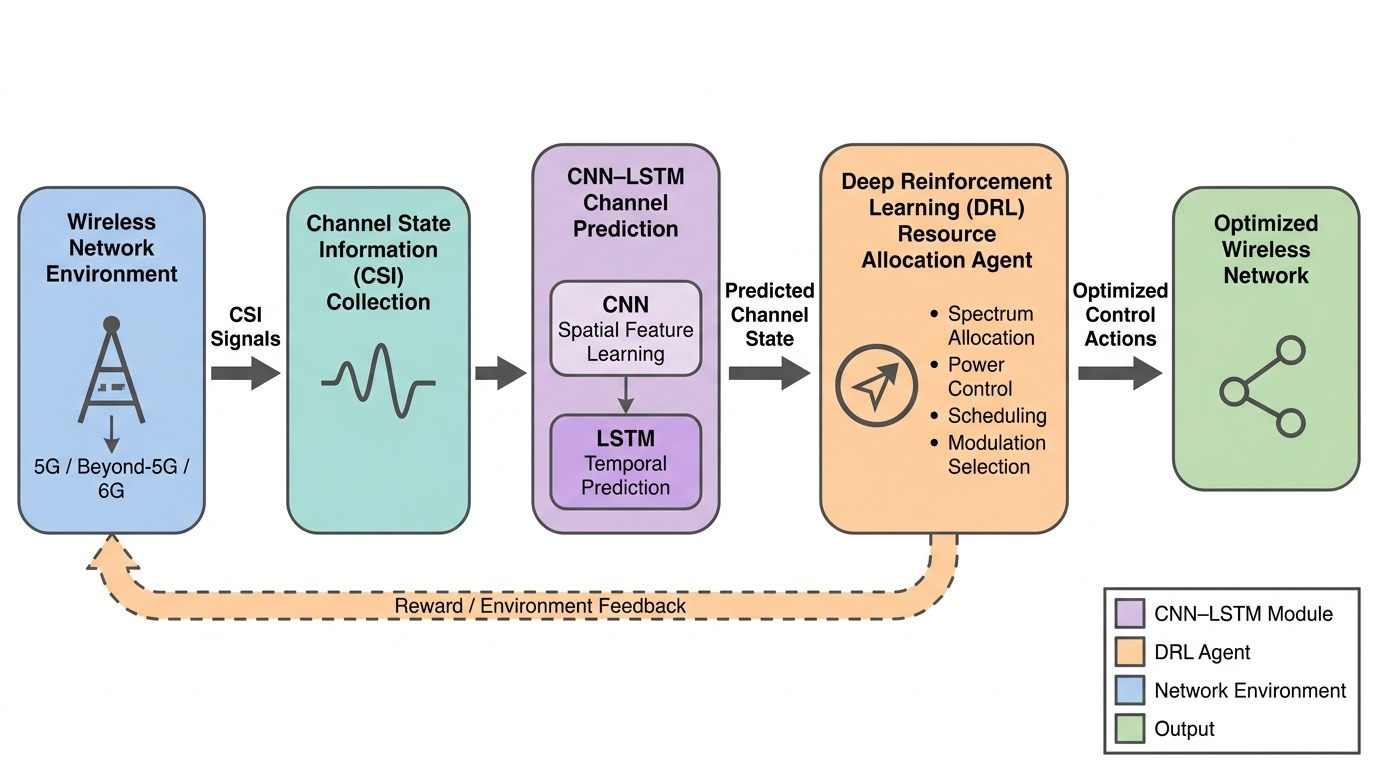
High-speed wireless communication systems underpin the data-intensive demands of contemporary 5G deployments and the emerging 6G paradigm, yet sustaining high throughput, low latency, and dependable connectivity in channels that shift rapidly varying channels remains an open engineering challenge. This paper presents an ML-driven framework that combines a deep reinforcement learning (DRL)-based scheduler with a hybrid CNN-LSTM channel predictor to jointly optimize radio resource allocation, modulation order, transmit power, and bandwidth..
Available Online: 31 Jul 2026
Volume 3
Miguel Angel Vargas Cruz
miguelangel@grupoalianzaempresarial.com
Available Online: 30 Jun 2026
Volume 3
Gabriel Silva-Atencio
gsilvaa468@ulacit.ed.cr
We use cookies to improve your experience on our site. By continuing to use our site, you accept our use of cookies. Learn more