


 ACCESS
Research Article
ACCESS
Research Article
Volume 3, Article ID: 2026.0040

Idowu Olugbenga Adewumi
adexio2010@gmail.com

Wumi Ajayi
ajayiw@babcock.edu.ng
Oluwafisayo Babatope Ayoade
22053430@student.westernsydney.edu.au
Victoria Bolanle Oyekunle
bola.oyekunle@lcu.edu.ng
Akintayo Ayoade
akintayo.a@lcu.edu.ng
Azeez Ajani Waheed
waheed.azeez@lcu.edu.ng
1 Department of Computer Science, School of Engineering, Federal College of Agriculture, Ibadan, Nigeria
2 Software Engineering, School of Computing, Babcock University, Ilisan Remo, Ogun State, Nigeria
3 School of Computer, Data and Mathematical Sciences, Computing and Engineering, Western Sydney University, Austrialia
4 Department of Computer Science, Faculty of Natural and Applied Science, Lead City University, Ibadan, Nigeria
* Author to whom correspondence should be addressed
Received: 29 Apr 2026 Accepted: 17 Aug 2026 Available Online: 17 Aug 2026
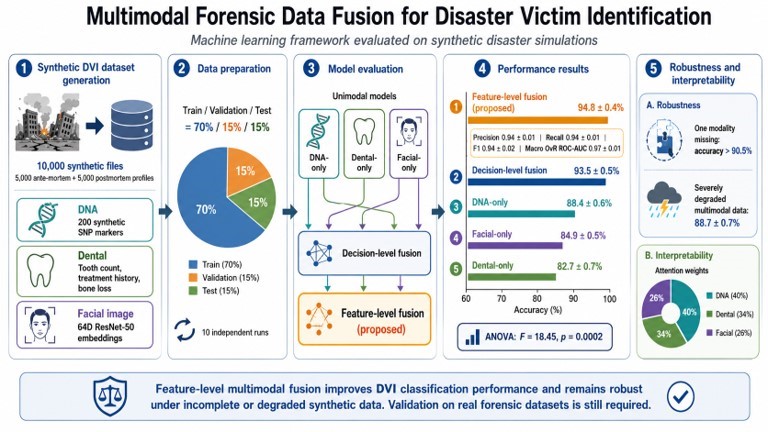
Using synthetic disaster simulations, a machine learning-based multimodal forensic data fusion framework was developed for disaster victim identification (DVI). By integrating DNA, dental, and facial picture data from 10,000 synthetic files, the framework comprised 5,000 ante-mortem and 5,000 postmortem profiles. DNA data were represented using 200 synthetic SNP markers, while each phenotype dental was represented using features tooth count, treatment history, and bone loss, and facial data represented trait as 64D ResNet-50 embeddings. The dataset was divided into training, validation, and testing datasets on the ratio of 70:15:15. Three unimodal models and two fusion strategies were evaluated in 10 independent runs. The proposed model of feature-level fusion showed the best performance with 94.8 ± 0.4 % accuracy, 0.94 ± 0.01 precision, 0.94 ± 0.01 recall, 0.94 ± 0.02 F1 and 0.97 ± 0.01 macro-averaged OvR ROC-AUC. The accuracy of decision-level fusion was 93.5% ± 0.5, which is better than the DNA-only (88.4% ± 0.6), dental-only (82.7% ± 0.7), and facial image-only (84.9% ± 0.5) classifiers. When one model out of three was missing, the accuracy declined to more than 90.5%. Under severely degraded multimodal conditions, the accuracy was 88.7% ± 0.7. ANOVA revealed significant differences between unimodal and fusion models (F = 18.45, p = 0.0002). Attention weights assigned 40% to DNA, 34% to dental, and 26% to facial data thus explains the interpretability. The results show good performance on synthetic DVI simulations but require testing on actual forensic data.
Disclaimer: This is not the final version of the article. Changes may occur when the manuscript is published in its final format.