

 ACCESS
Research Article
ACCESS
Research Article
Volume 3, Article ID: 2026.0037

Gabriel Silva Atencio
gsilvaa468@ulacit.ed.cr

Latin American University of Science and Technology (ULACIT), San José, Costa Rica
Received: 08 Jan 2026 Accepted: 30 Jun 2026 Available Online: 30 Jun 2026
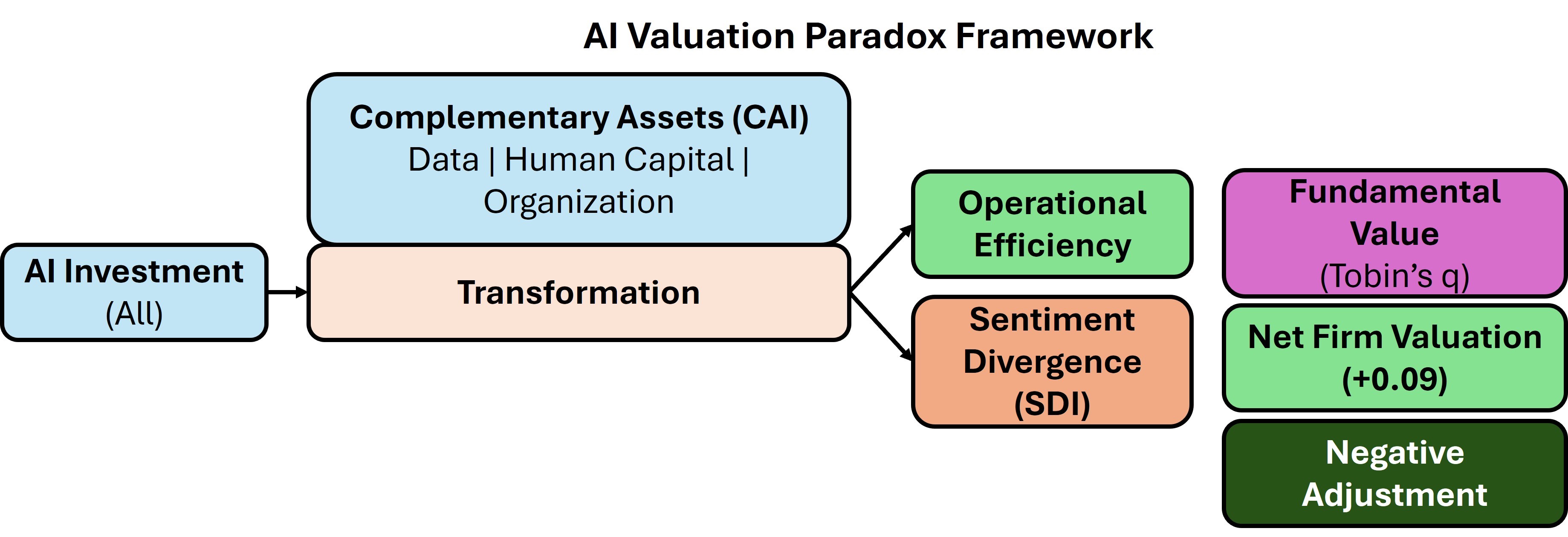
The 'AI Valuation Paradox' refers to the persistent gap between how much companies invest in artificial intelligence and how those investments are reflected in market valuations for S&P 500 firms. This study helps explain this paradox by showing that AI is not valuable in isolation; rather, value emerges when AI is combined with firm-specific complementary assets. When you invest in AI, you get negative marginal gains that are not important. The main new idea is to formalize and evaluate an integrated valuation method that divides firm value into three parts: basic value, real-option premium, and behavior-happiness adjustment. This model can explain 53% of the changes in Tobin's q. A study of dynamic events talks about a predicted "integration dip," which shows that the initial mood, which is lifted by story-driven hype, sharply corrects itself during operational implementation, which causes systemic instability. The results show that this difference exists because we are using tools from the Industrial Age to value assets from the Information Age, and the market constantly undervalues organizational change that is difficult and depends on the path. The results can be used and are important for two things: planning plans and looking at money.
Disclaimer: This is not the final version of the article. Changes may occur when the manuscript is published in its final format.