


 ACCESS
Research Article
ACCESS
Research Article
Volume 1, Article ID: 2026.0006

DEEPA NAIK
naiksavantdeepa@gmail.com

Department of Computer Science and Engineering, Dr. B. C. Roy Engineering College, Durgapur, West Bengal, India.
Received: 04 Apr 2026 Accepted: 29 Jul 2026 Available Online: 30 Jul 2026
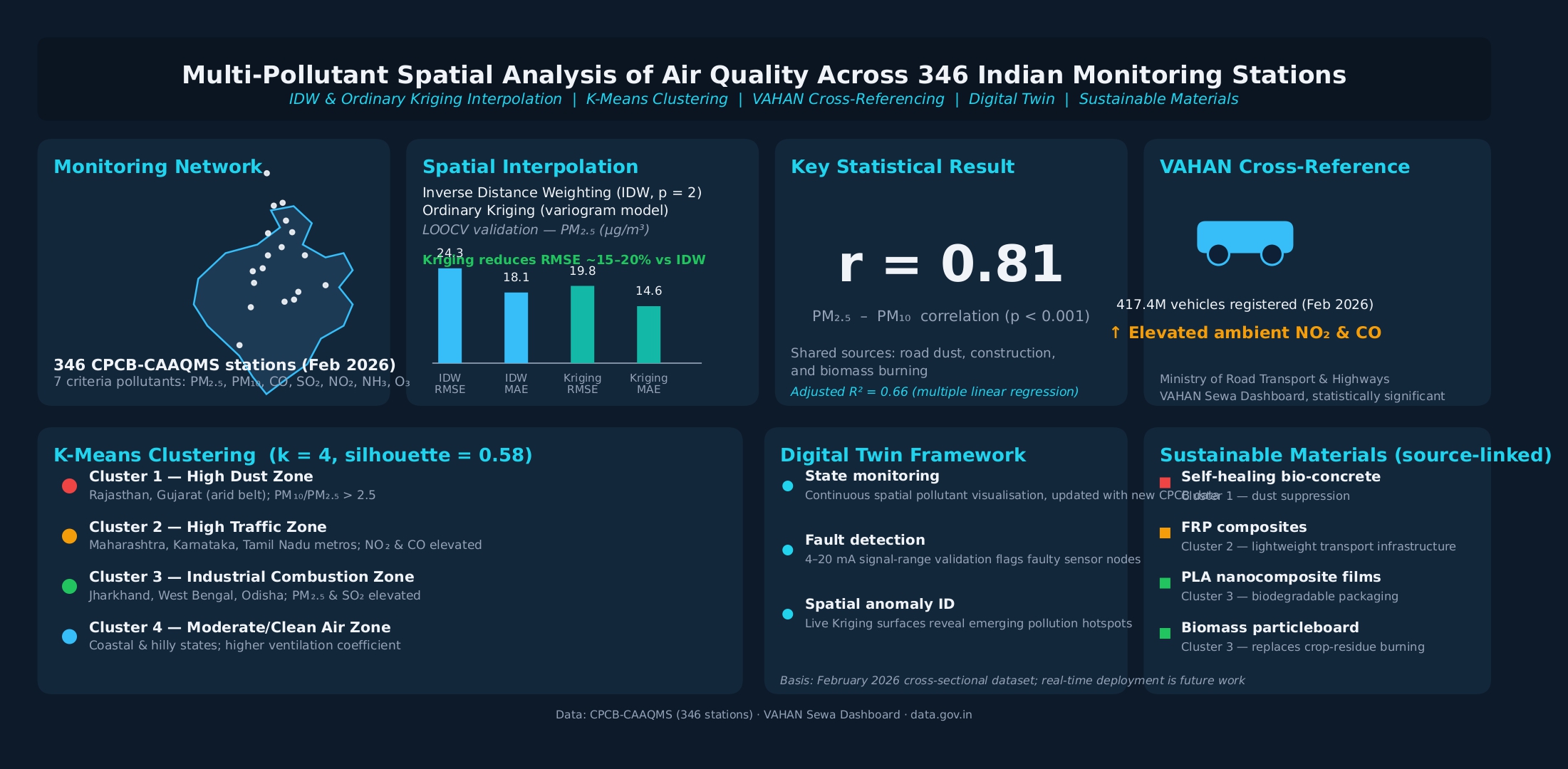
Deteriorating air quality is a critical public health challenge globally, and India ranks among the most severely affected nations. This study presents a multi-pollutant spatial analysis of air quality across 346 monitoring stations in India, using high-resolution data from the Central Pollution Control Board's Continuous Ambient Air Quality Monitoring System (CPCB-CAAQMS). Precise geographic coordinates (latitude and longitude) were used to apply two spatial interpolation methods — Inverse Distance Weighting (IDW, power parameter p = 2) and Ordinary Kriging — to transform discrete station-level measurements into continuous pollution surfaces across Indian territory. Pearson's correlation analysis, multiple linear regression, and k-means clustering (k = 4) were employed to identify inter-pollutant relationships and classify monitoring regions into pollution regime clusters. Results reveal that PM₂.₅ and PM₁₀ consistently exceed World Health Organization (WHO) guidelines across India, particularly in the Indo-Gangetic Plain (IGP), while SO₂ and CO remain within permissible limits in most regions. A strong linear correlation (r = 0.81) between PM₂.₅ and PM₁₀ suggests shared sources including road dust, construction activity, and biomass burning. Cross-referencing with the Ministry of Road Transport and Highways' VAHAN Sewa Dashboard establishes a statistically significant association between cumulative vehicle registration density and elevated ambient NO₂ and CO levels. A Digital Twin framework is proposed for real-time atmospheric monitoring, sensor fault detection, and spatial anomaly identification. Sustainable material-based mitigation strategies — including self-healing bio-concrete, reinforced PLA packaging films, and fibre-reinforced polymer composites — are recommended as source-level interventions directly linked to the dominant pollutant types identified in this analysis.
Disclaimer: This is not the final version of the article. Changes may occur when the manuscript is published in its final format.