

 ACCESS
Review Article
ACCESS
Review Article
Volume 2, Article ID: 2026.0018
Krishnagowdu Saravanan
saravanankrishnagowdu95@gmail.com

Preethi Uthayakumar
upreethiuthay@gmail.com

Sundarasamy Dhanapal
dhanapalu@gmail.com

Chinnappan Deepa Joan Of Arc
deepafredrick.ds@gmail.com

1 Post Graduate and Research Centre in Biotechnology, School of Life Sciences, Arignar Anna College (Arts & Science), Krishnagiri – 635 115, Tamil Nadu, India (Affiliated to Periyar University, Salem – 636 011, Tamil Nadu, India)
2 Department of Science, Delhi Public School, Bangalore South, Bangalore- 560 111, Karnataka, India
* Author to whom correspondence should be addressed
Received: 25 Oct 2025 Accepted: 26 Sep 2026 Available Online: 28 Sep 2026
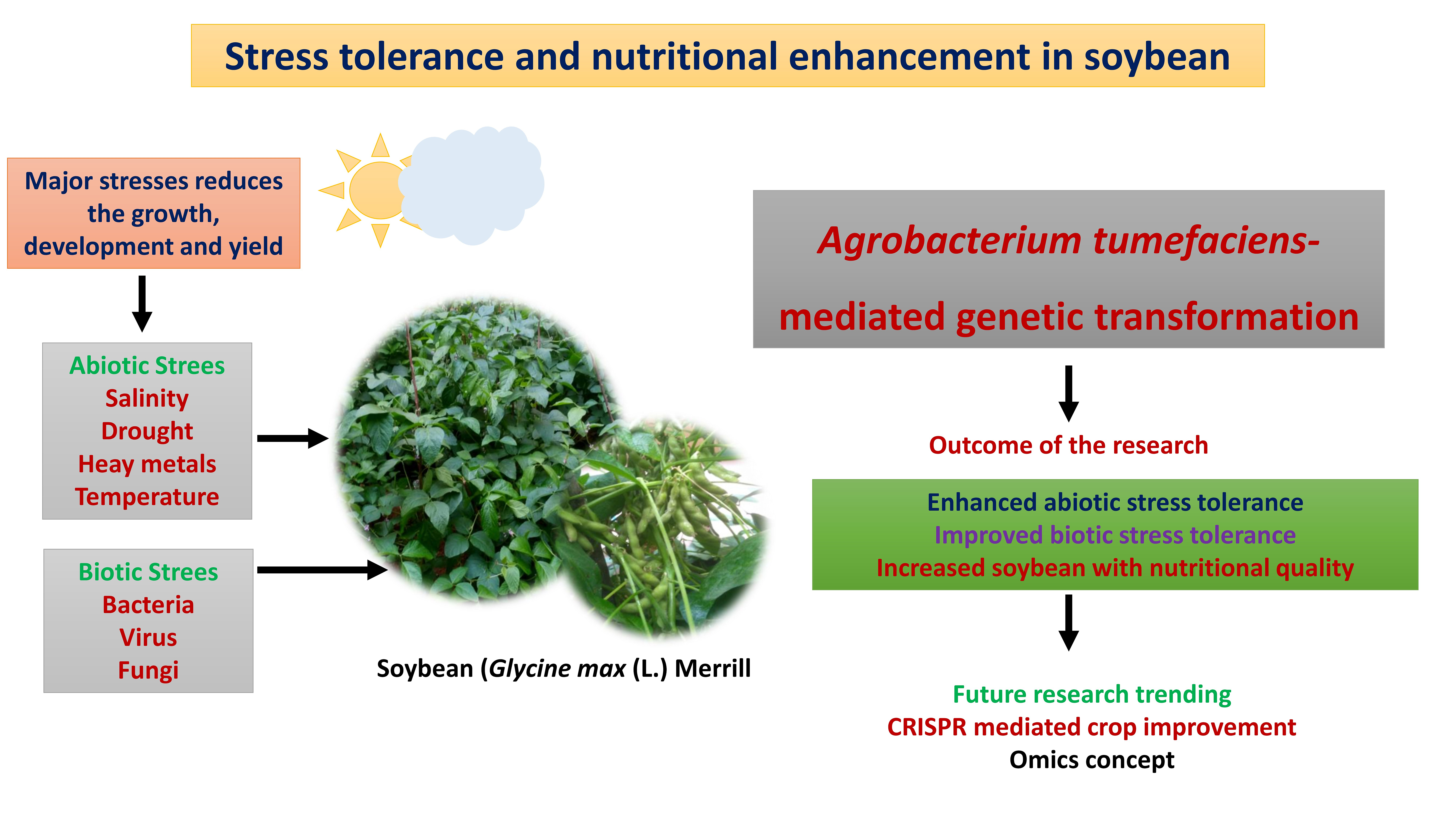
Soybean (Glycine max (L.) Merrill), is a major legume crop in the family Fabaceae. It is significant source of plant-based protein and oil, which is important determinant in the food and nutritional security of the world. However, its productivity is progressively being limited by the abiotic stresses (drought and salinity), and biotic stresses (diseases and pests). Conventional breeding has limited success due to the complex genetics of stress-responsive traits and prolonged breeding cycles. Therefore, this review critically evaluates recent advances in Agrobacterium tumefaciens-mediated transformation for soybean improvement, focusing on stress tolerance, nutritional enhancement, and transformation efficiency. This review explains about current knowledge on major stress-responsive genes and transcription factors, including DREB, NAC, bZIP, and WRKY families, in addition to Osmo protective, antioxidant, and protein/oil quality-associated genes that contribute to soybean improvement. Furthermore, optimized transformation parameters, including explant selection, infection conditions, and selection strategies, are comparatively discussed to highlight emerging trends in transformation efficiency. In spite of substantial progress, persistent challenges such as genotype dependency, limited transformation efficiency, low reproducibility, and regulatory constraints continue to hinder the large-scale application of transgenic soybean technologies. Henceforth, emerging strategies including gene stacking, genome editing, and advanced vector systems are discussed as promising approaches to overcome these limitations. Agrobacterium-mediated transformation is a valuable tool for functional genomics and soybean improvement. Its integration with genome-editing technologies, systems biology, and conventional breeding can accelerate the development of climate-resilient, nutritionally enhanced soybean cultivars.
Disclaimer: This is not the final version of the article. Changes may occur when the manuscript is published in its final format.