


 ACCESS
Research Article
ACCESS
Research Article
Volume 2, Article ID: 2026.0017

Ahmadi
ahmadi@ulm.ac.id

Zulva Ainul Ilma
zulvaainul1@gmail.com

Irhamsyah
irhamsyah@ulm.ac.id

Faculty of Fisheries and Marine Science, Lambung Mangkurat University, Banjarbaru 70714, Indonesia
* Author to whom correspondence should be addressed
Received: 19 Jul 2026 Accepted: 07 Sep 2026 Available Online: 08 Sep 2026
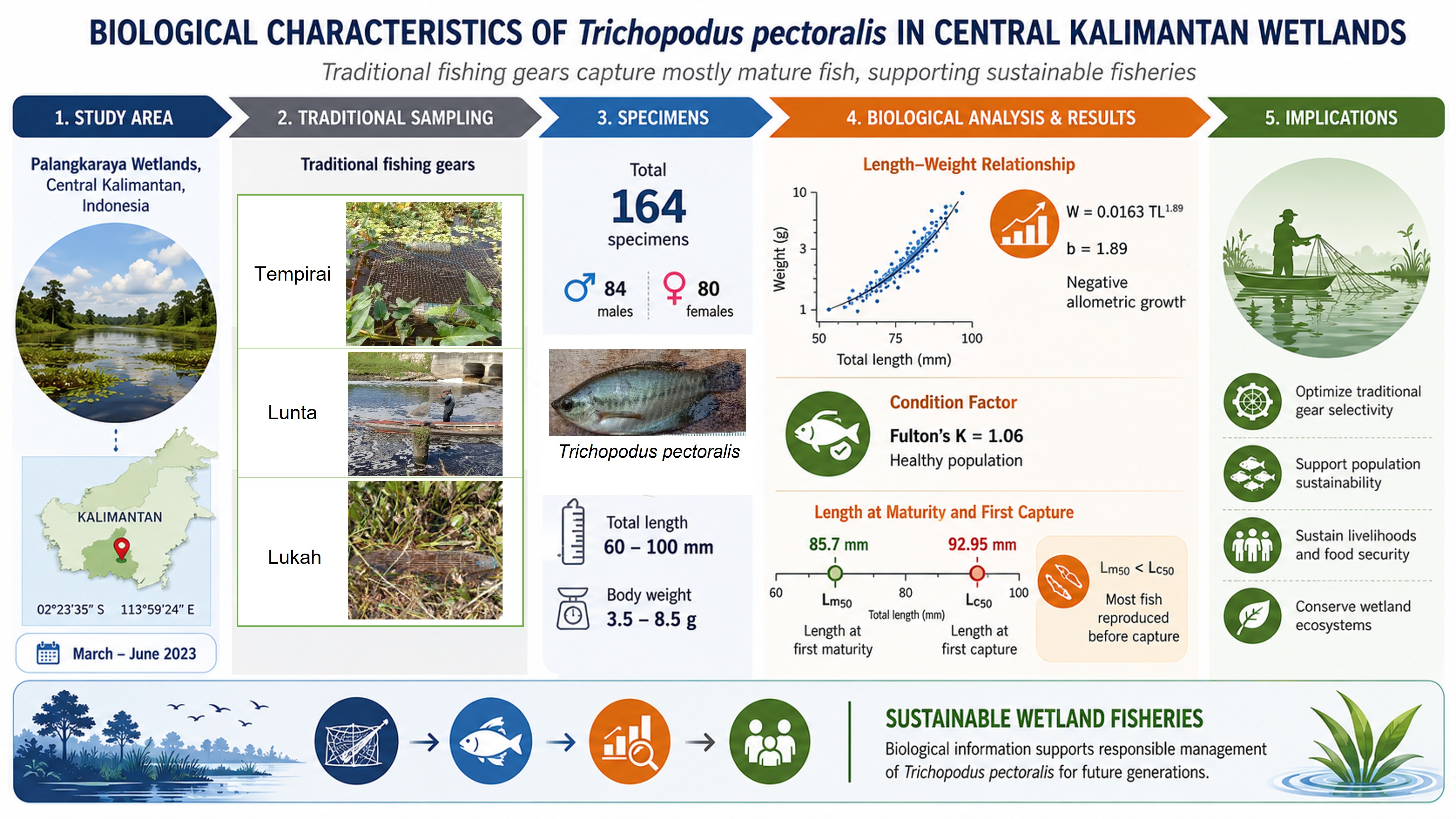
This study evaluated the growth pattern, condition factor, and reproductive size parameters of snakeskin gourami, Trichopodus pectoralis, collected from wetlands in Palangkaraya City, Indonesia. Sampling was conducted from March to June 2023 using three traditional fishing gears (Tempirai, Lunta, and Lukah), yielding 164 specimens comprising 84 males and 80 females. Total length ranged from 60 to 100 mm (83.45 ± 0.74 mm), while body weight ranged from 3.5 to 8.6 g (6.13 ± 0.11 g). The sex ratio did not significantly differ from the expected 1:1 ratio (χ² = 0.098, p > 0.05), and no significant differences in fish size were observed between sexes or among fishing gears (p > 0.05). Length–weight relationship analysis showed a negative allometric growth pattern (b = 1.8856; R² = 0.8511), indicating that fish length increased faster than body weight, while the mean Fulton’s condition factor (K = 1.06 ± 0.02) suggests generally healthy individuals despite relatively small body size. The estimated length at first maturity (Lm50 = 85.70 ± 0.07 mm TL) was lower than the length at first capture (Lc50 = 92.95 ± 0.06 mm TL), indicating that most individuals likely reproduced before being captured. This study provides baseline biological information on the growth, condition, and reproductive size structure of T. pectoralis in the Palangkaraya wetlands, contributing empirical evidence for size-based fisheries management. These findings suggest that current fishing practices may still support population sustainability. However, the predominance of relatively small-sized fish underscores the importance of adaptive fisheries management through fishing pressure monitoring, improved gear selectivity, and the integration of biological and socio-economic considerations to sustain T. pectoralis populations in wetland ecosystems.
Disclaimer: This is not the final version of the article. Changes may occur when the manuscript is published in its final format.