

 ACCESS
Research Article
ACCESS
Research Article
Volume 2, Article ID: 2026.0016
Tupura Khatun
tupurakhatun098@gmail.com

Md. Asaduzzaman
bitatipu@gmail.com

1 Department of Mathematics, Chittagong College, National University, Bangladesh
2 Department of Food Engineering and Nutrition Science, Kanchan Bridge, Purbacahal 1461, Bangladesh, State University of Bangladesh
3 State Key Laboratory of Food Science and Resources, Jiangnan University, Wuxi, 214122, China.
4 School of Food Science and Technology, Jiangnan University, 1800 Lihu Avenue, 214122 Wuxi, Jiangsu Province, China
* Author to whom correspondence should be addressed
Received: 28 Apr 2026 Accepted: 13 Aug 2026 Available Online: 14 Aug 2026
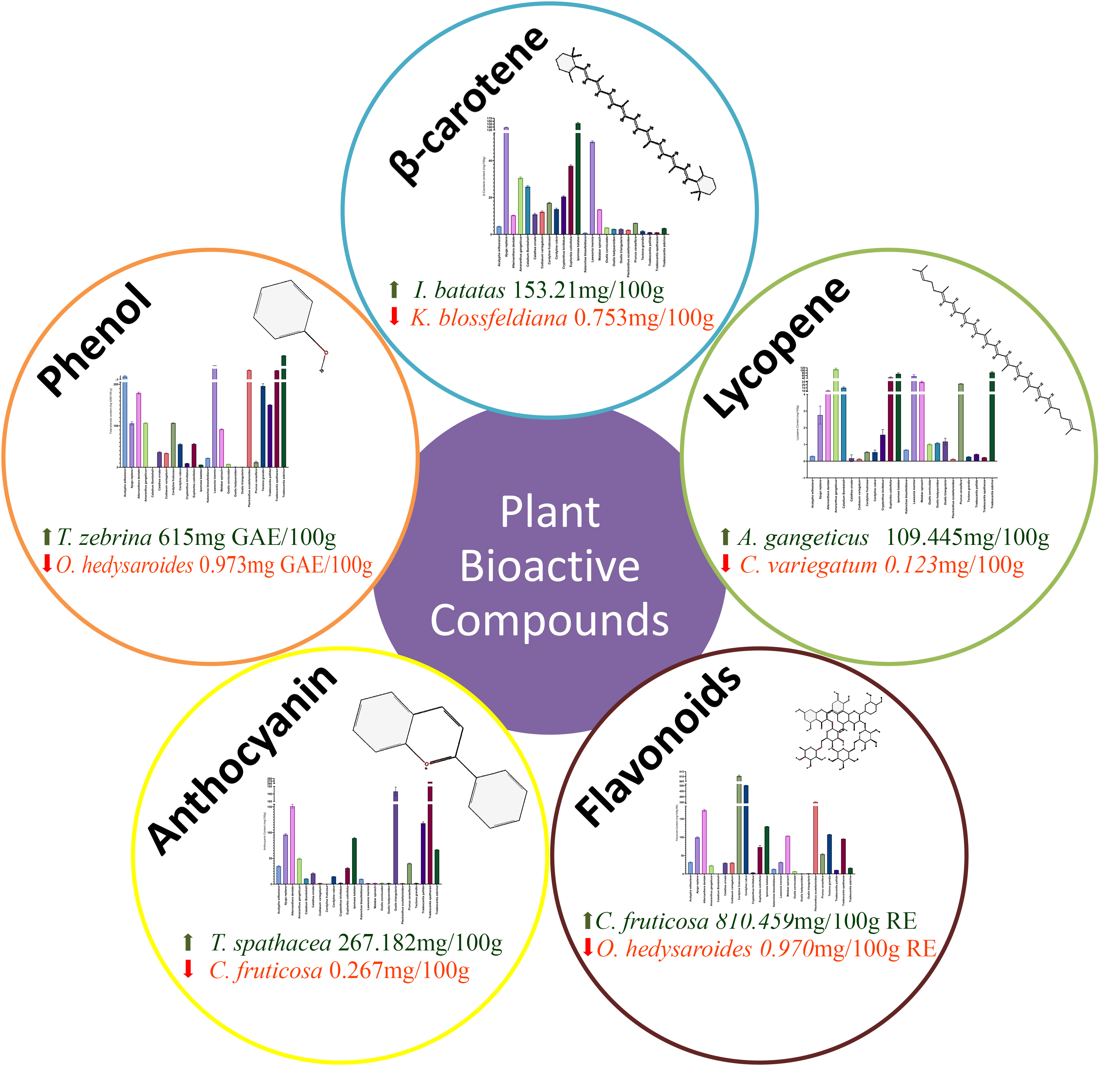
The medicinal and nutritional benefits of various plant leaves are a rich source of phytochemicals, which play vital roles in providing better solutions for other diseases. . In this study, quantified the levels of bioactive compounds in the leaves of twenty-four medicinal plant species collected in Bangladesh from the National Botanical Garden, Dhaka, Bangladesh, based on visual coloration and documented medicinal uses in traditional and local Bangladeshi medicine. . Bioactive compounds, including total phenol content, flavonoids, β–carotene, anthocyanins, and lycopene levels, were quantified and evaluated. The T80 U/VIS Spectrophotometer (PG Instruments, United Kingdom) was used to estimate and assess the levels of these bioactive compounds, a method that is simple, rapid, and cost-effective, where fresh leaf extracts were analyzed in triplicate at specific wavelengths, and data were subjected to one-way ANOVA followed by Duncan's Multiple Range Test (P ≤ 0.05). Ipomoea batatas (Sweet potato), Amaranthus gangeticus (Red spinach), Cordyline fruticosa (Ti plant), Tradescantia spathacea (Boatlily), Tradescantia zebrine (Wandering dude) showed the maximum level of β – carotene content (153 mg/100g), lycopene content (109 mg/100g), flavonoid content (810 mg/100g RE), anthocyanin content (267 mg/100g) and phenolic content 615 mg GAE/100g respectively. Pearson correlation analysis identified extremely strong positive relationships between β-carotene and lycopene (r = 0.9264) and between anthocyanins and total phenolic content (r = 0.9712), indicating common metabolic regulation. These selected plants could be considered a new natural source of bioactive compounds and could open future applications in the food, chemistry, and pharmaceutical industries. This study identified novel insights into the bioactive compositions of tropical medicinal plants.
Disclaimer: This is not the final version of the article. Changes may occur when the manuscript is published in its final format.