


 ACCESS
Research Article
ACCESS
Research Article
Volume 2, Article ID: 2026.0014

Ayesha ABDUL QADIR
ayeshaqadir808@gmail.com


Ghulam Murtaza
gmurtazauaf@gmail.com


Zia Ur Rahman Farooqi
ziaa2600@gmail.com


Umair Riaz
umair.riaz@mnsuam.edu.pk


Predrag ILIĆ
predrag.ilic@institutzei.net

1 Institute of Soil and Environmental Sciences, University of Agriculture Faisalabad 38040, Pakistan
2 Institute of Surface-Earth System Science, Tianjin University, 92 Weijin Road, Tianjin 300072, China
3 Yunnan Provincial Key Lab of Soil Carbon Sequestration and Pollution Control, Faculty of Environmental Science and Engineering, Kunming University of Science and Technology, Kunming 650500, China.
4 Yunnan International Joint Laboratory for Emission Reduction and Carbon Sequestration in Agricultural Soils, Kunming 650500, China
5 Department of Soil and Environmental Sciences, Faculty of Agriculture and Environmental Sciences, MNS-University of Agriculture Multan, Multan, 66000, Pakistan
6 PSRI Institute for Protection and Ecology of the Republic of Srpska, Vidovdanska 43, Banja Luka 78000, Republic of Srpska, Bosnia and Herzegovina
* Author to whom correspondence should be addressed
Received: 25 Sep 2025 Accepted: 15 Jun 2026 Available Online: 16 Jun 2026
This article is part of the Special Issue Persistent Chemical Contaminants and Organic Pollutants in Food Systems: Insights into Food Safety and Human Health
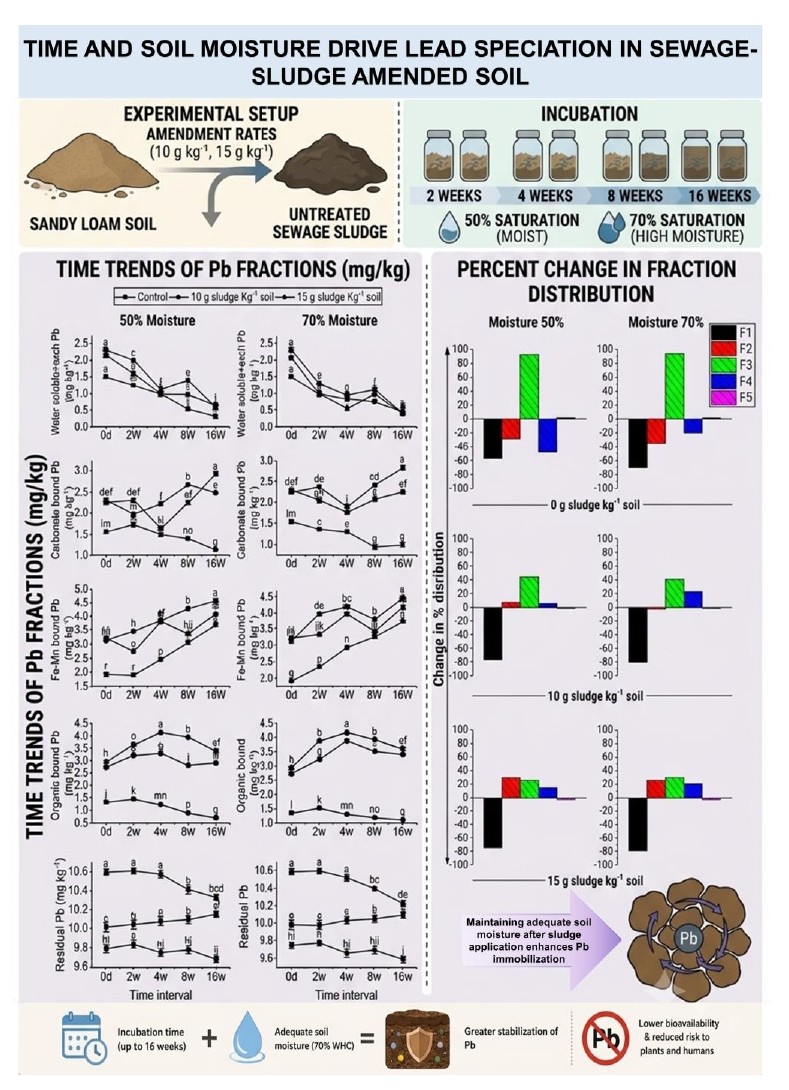
The application of sewage sludge to agricultural soils is increasingly considered a sustainable option for waste disposal, nutrient recycling, and soil fertility improvement. However, sewage sludge may also introduce potentially toxic elements (PTEs), particularly lead (Pb), into soil systems, where their environmental risk depends largely on chemical speciation rather than total concentration alone. Lead in sewage sludge-amended soils poses a potential threat to food sustainability through crop uptake and subsequent entry into the human food chain. This study investigated the effects of incubation time and soil moisture on Pb fractionation in sewage sludge–amended soil under controlled experimental conditions. The sandy loam soil, amended with untreated sewage sludge at rates of 10 and 15 g kg⁻¹ soil, was incubated for 16 weeks under two moisture conditions (50% and 70% saturation percentage). Soil samples were collected after 2, 4, 8, and 16 weeks and subjected to sequential extraction to determine exchangeable (F1), carbonate-bound (F2), Fe–Mn oxide-bound (F3), organic-bound (F4), and residual (F5) Pb fractions. The application of sewage sludge significantly increased total Pb concentration compared with the unamended control, with higher application rates showing higher levels of Pb accumulation. Across all treatments, Pb was predominantly associated with the F5, followed by F3 and F4. With increasing incubation time, Pb was progressively redistributed from more labile forms, particularly the F1, into less bioavailable fractions such as F3 and F4 pools. Higher soil moisture (70%) accelerated the decline in exchangeable Pb (F1) and enhanced Pb stabilization compared with 50% moisture. In contrast, the F5 remained relatively constant throughout the incubation period. The results indicate that both ageing time and soil moisture conditions regulate Pb transformation in sludge-amended soils. Maintaining high soil moisture levels may promote the transformation of Pb into stable geochemical forms, thereby reducing its mobility and bioavailability, and further mitigating potential environmental risks.
Disclaimer: This is not the final version of the article. Changes may occur when the manuscript is published in its final format.