


 ACCESS
Research Article
ACCESS
Research Article
Volume 3, Article ID: 2026.0019

José G. Parra
jgparra2@uc.edu.ve

Department of Chemistry, Faculty of Experimental Sciences and Technology, University of Carabobo, Laboratory of Molecular Simulation for Experimental Chemistry (SIMOLQUIMEX), Chemistry Building, Salvador Allende Avenue, Bárbula, Venezuela
Received: 01 May 2026 Accepted: 22 Jul 2026 Available Online: 23 Jul 2026
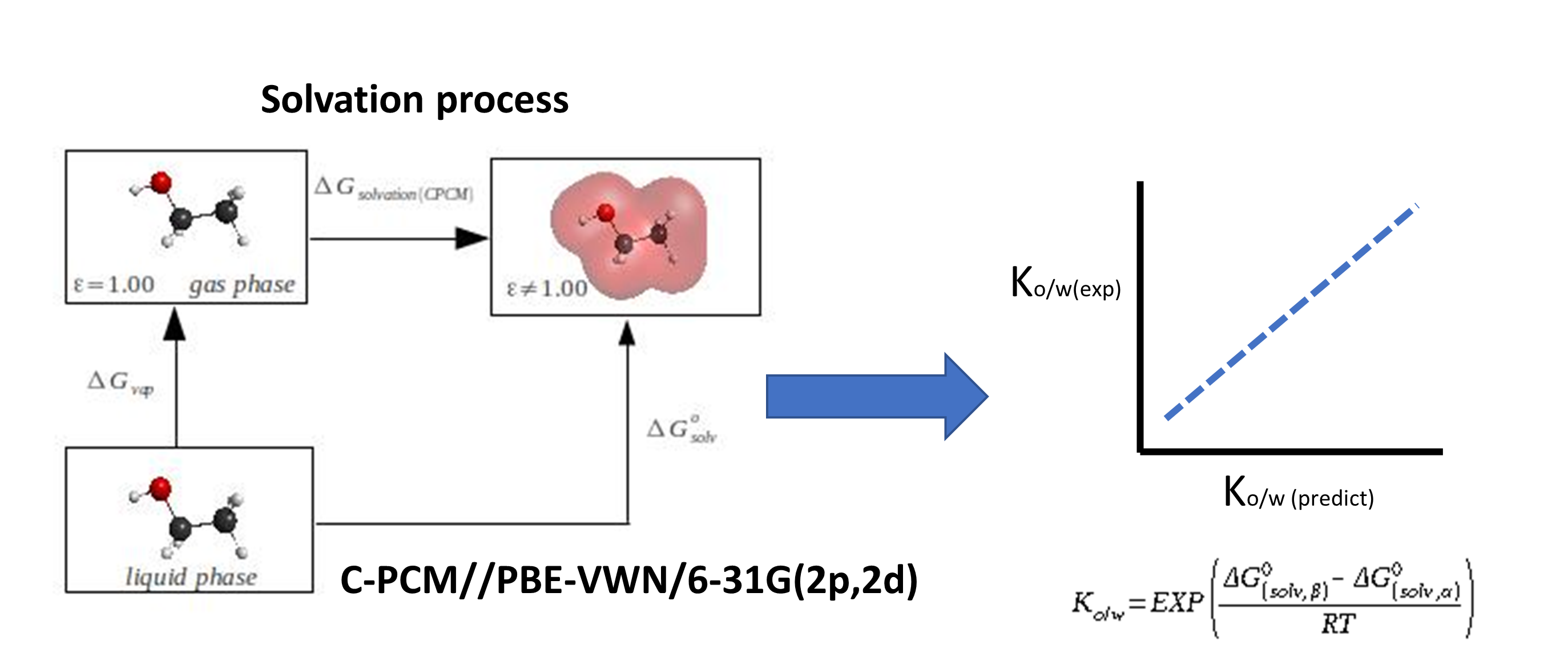
Using the method of solvation Conductor-like Polarizable Continuum Model (C-PCM) and the method of Amovilli-Menucci contained in the GAMESS-US package, were estimated the electrostatic, dispersion and repulsion free energies of organic molecules in 1-octanol and water. The calculations of solvation in water and 1-octanol were performed using the method C-PCM//PBE-VWN/6-31G (2p, 2d), to determine the electrostatic contribution to the solvation free energy. Consequently, using the concept of structure-property relationship was obtained a QSPR model to estimate the cavitation free energies of organic molecules with the experimental solvation free energies. Additionally, with the surface atomics (C, H, N and O) of the atoms that conform to the organic molecules calculated by the method GEPOL-GB, the electrostatic free energies, and non-bonding free energies, two QSPR models were constructed to predict the 1‑octanol/water partition coefficient (logP) for neutral organic molecules containing a single functional group from the following classes: alcohols, ketones, aldehydes, carboxylic acids, esters, ethers, amines, alkanes (linear and cyclic), and aromatic compounds. Model A, which uses electrostatic free energies and atomic surface areas, achieved a correlation coefficient of R² = 0.991, while Model B, which incorporates non-bonding free energies, achieved R² = 0.986. The applicability domain of the models is explicitly defined for monofunctional compounds at infinite dilution and 298.15 K.
Disclaimer: This is not the final version of the article. Changes may occur when the manuscript is published in its final format.