


 ACCESS
Research Article
ACCESS
Research Article
Volume 2, Article ID: 2025.0024

Jehan Kadhim Shareef Al-Safi
jihan.k.shareef@utq.edu.iq


Abbas Thajeel Rhaif Alsahlanee
abbas.thajeel@utq.edu.iq

1 Digital Media Department, Faculty of Media, University of Thi-Qar, Nasiriyah 64001, Thi-Qar, Iraq
2 Faculty of Education for Humanities, University of Thi-Qar, Nasiriyah 64001, Thi-Qar, Iraq
* Author to whom correspondence should be addressed
Received: 09 Jul 2025 Accepted: 06 Nov 2025 Available Online: 10 Nov 2025 Published: 25 Nov 2025
Intelligent Reflecting Surfaces (IRSs) are essential for energy-efficient 6G networks; however, enhancing their performance to attain both elevated data rates and energy efficiency continues to be a formidable challenge. This paper uses artificial intelligence (AI) to solve this problem by creating a new AI-based optimization algorithm called Dynamic and Static Particle Swarm Optimization (DS-PSO). The suggested AI method intelligently learns the best phase-shift settings for IRS elements, balancing exploration and exploitation in real time to get the best signal-to-noise ratio at the receiver. The simulation results show that our method works, with the AI-optimized IRS model being up to 269% more energy-efficient than a standard IRS at 10 bits/s/Hz. This study highlights the considerable potential of AI algorithms in navigating the complex trade-offs of next-generation communication systems, establishing our model as a robust solution for sustainable 6G connectivity.
The intelligent reflecting surface (IRS) has emerged as a promising technology for sixth-generation (6G) wireless communication systems by improving propagation environments and mitigating the effects of high path loss in line-of-sight (LOS) conditions [1]. An intelligent radio environment has recently been developed to meet the stringent criteria for communication and sensing imposed by future 6G systems [2]. In this approach, the digitally-controlled metasurface, also known as a reconfigurable intelligent surface (RIS) or IRS, wirelessly alters the propagation environment to enhance wireless communication and radar sensing [3]. Metasurfaces are a novel type of functional material containing artificially periodic or quasiperiodic structures on sub-wavelength length scales [4,5]. The active elements in IRS metasurface unit cells allow for the electrical adjustment of electromagnetic waves, which means they can be programmed [6,7]. Metasurfaces show negative permeability and permittivity [8]. Metasurfaces may change electromagnetic waves from microwaves to visible light. Wireless link quality varies over time due to the unpredictable nature of radio propagation. During the propagation of electromagnetic waves, free-space line-of-sight (LOS) paths, reflections, refractions, signal absorption, and diffraction caused by physical objects render wireless channels highly dynamic [9]. The ability of the IRS to manipulate electromagnetic waves in real time opens up new possibilities, shifting the wireless communication design paradigm from “adapting to wireless channels” toward “actively shaping wireless channels”[9,10]. In particular, IRS can achieve desirable functions by dynamically regulating phase shifts using low-cost reflecting elements, including multi-antenna/MIMO (multiple-input multiple-output) channel rank improvement, environment obstacle avoidance, and reshaping channel realizations/distributions [11]. Improved communication system performance is possible when transmit beamforming is used with an IRS that uses a phase-shift design [12,13]. Transmit beamforming can also synthesize multiple beams toward existing users and targets [12,13,14]. The creation of the IRS reflection pattern (passive beamforming) requires channel state information (CSI) for the subchannels between wireless transceivers and the IRS [15]. The IRS cannot detect the incident signal because it is passive, making the estimation process more complex than in other wireless communication systems [16]. Furthermore, prior research has broadened the scope of investigation to incorporate general channel effects, such as fading, alongside practical imperfections, including transceiver misalignment, phase inaccuracies, and interference from mobile users [17,18]. In contrast, dynamically optimizing the phase can strengthen the communication signal [19]. Multiple performance metrics, such as spectral efficiency (SE), transmit power, sum rate, throughput, security, and others, have been the focus of substantial research into the use of IRS in wireless communication [20]. In addition, the literature has discussed the energy efficiency (EE) metric as a means of assessing the performance of IRS within wireless communication networks, as in [2,10,20]. We have performed multiple studies on the application of AI-driven optimization for recommender systems, communications, and networks, including [21,22,23,24,25,26]. The goal of this study is to improve the energy efficiency of an IRS-enabled system, which will improve transmission performance in 6G wireless networks without lowering data rate requirements. Using AI techniques to reprogram the IRS system can make the new models work better. To make the standard IRS model work better, an AI algorithm called DS-PSO (dynamic and static particle swarm optimization) has been suggested. The IRS system can handle the most data at the fastest speeds while using the least amount of energy. So, the choice between standard IRS and optimized IRS (IRS⁰) models affects how much energy they use and how fast they send data. The data rate affects how energy-efficient an IRS is. Data rate and energy efficiency are both increased by the proposed optimization algorithm. However, for the (IRS⁰) model, the necessary energy-efficiency improvement is determined by the target data rate. As a result, the energy efficiency and data rates of the (IRS⁰) model are examined using the mathematical formulations created in this work. IRS-assisted communication has a solid foundation thanks to the literature currently in publication, but there are still a number of unmet research needs, which this work attempts to address. First off, a lot of research concentrates on throughput or spectral efficiency optimization, but it doesn’t thoroughly examine the crucial trade-off between high data rates and energy efficiency (EE) in multi-IRS 6G scenarios. Second, although algorithms like Genetic Algorithm (GA) and standard PSO have been used, they frequently result in premature convergence to local optima in the intricate, high-dimensional IRS phase-shift optimization problem, suggesting the need for more reliable hybrid optimization strategies. Lastly, there is a lack of a standardized benchmarking framework in the literature that uses energy efficiency versus data rate as a useful performance metric to compare the suggested models with standard IRS, SISO, and a number of well-known schemes (such as single, double, triple IRS, PSO-IRS, and GA-IRS). This paper seeks to address these shortcomings by presenting a novel AI-driven hybrid algorithm and a comprehensive comparative performance assessment. The main new ideas in this paper are: (1) We introduce a novel hybrid Dynamic and Static Particle Swarm Optimization (DS-PSO) algorithm, meticulously designed to rectify the deficiencies of traditional optimizers in the complex, non-convex realm of IRS phase-shift optimization. Its hybrid topology does a better job of balancing exploration and exploitation. (2) A complete analytical framework is created for the (IRS⁰) model to find the most important performance metrics for energy efficiency and data rate. (3) We perform a comprehensive simulation study that compares the proposed model to a standard IRS, a SISO baseline, and the most recent works in the field (such as PSO-IRS, GA-IRS, and multi-IRS configurations). (4) We show that the (AI-IRS⁰) model works much better than a standard IRS when there is a lot of data, with energy efficiency improvements of up to 269%. This shows that it could be a key technology for 6G networks. The rest of this paper is set up like this. In Section 2, we talk about the system model, the analytical performance framework, and the suggested AI-based optimization method. In Section 3, we show the results of the simulation and how they compare to each other. Section 4 talks about problems that come up when putting things into practice. Lastly, Section 5 will talk about the conclusion and what needs to be done next.
This section outlines the system model, analytical performance framework, and the proposed AI optimization algorithm used to evaluate the enhanced IRS-aided 6G communication system. 2.1. System Model Here, we focus on one-to-one transmissions, where the source and destination each have a single antenna, where
represents the deterministic flat-fading channel, while the destination receives a signal as in (1).
where
A higher transmission capacity during wireless communication can be achieved by using additional technologies. An IRS is one such technology that can enhance the data transmission capacity of wireless communication systems. IRSs can outperform relays at processing deterministic flat-fading channels, channel estimation, and frequency-selective fading. In terms of performance, deterministic flat-fading channels achieve the best performance [27].
For clarity and ease of mathematical manipulation, we employ deterministic flat-fading channels in our simulations and analysis. However, real-world wireless environments frequently experience frequency-selective fading. This makes it more difficult to compare the performance of IRS and relays.
One of the best features of relays is their ability to perform tasks like equalization and amplification, which can reduce inter-symbol interference brought on by fading that only impacts specific frequencies. An IRS cannot perform this type of active equalization since it is passive. It works well in wideband systems if it can make a frequency-flat response or if it uses more advanced, frequency-selective phase shift designs, which is an area of active research. So, even though IRS technology has big benefits in terms of power efficiency and possible spatial gain over relays in flat-fading channels, using it in environments with strong frequency selectivity needs to be thought about carefully and may involve trade-offs compared to active relays. This indicates a promising avenue for future research.
This paper examines IRS properties and develops an optimized IRS model. Subsequently, we compare the standard and (
) models to ascertain their strengths and weaknesses. To conduct this study, we created a comprehensive transmission diagram in the wireless communication system using either the standard IRS or the proposed (

2.1.1. The Transmission with the Support of the Standard IRS Model (IRS)
Discrete elements
exist in the standard IRS model (IRS), as shown in Figure 1, where
The rate expression in (5) will be obtained from the carrying capacity of a channel generating additive white Gaussian noise for any
. Take note that the essential factor is
2.1.2. The Transmission with the Support of the Optimized IRS Model ( I R S o )
In this paper, we present an improved version of the IRS model; it is the ( ) model (shown in Figure 1) utilizing one of the available optimization algorithms to surpass the performance and capabilities of the IRS.
The enhanced, as in the (7) diagonal matrix, shows the properties of the , just like in the IRS, except for the value of N.
Although the analysis in this paper simplifies by assuming deterministic channels, extending it to fading channels with complete channel information is straightforward. We need only consider predictions of the rate equations in (6) and (10). In light of this, all the conclusions also hold in this case.
2.2. Performance of Analytics
Here, we analyze the three achievable rates discussed in the previous section. Uniquely, the phases of the channel elements ignore only the amplitudes used in the expressions. From now on, the notation
, and
Equality will be obtained for
with the IRS and for
The radio transmission will work enhanced within this paper’s (
) model compared to the IRS described in the previous literature. The transmission supported by the (
As for the distinction between the transmission supported by the (
) and IRS; the IRS supports the case that
A LOS between the
, and IRSs are required to interpret the results correctly
The higher rate of (
) is provided by transmissions supported by the standard model of the IRS, as in [27]. It is contrary to what is in this paper; the highest rate of
The difference between
and
The coefficient
of the amplitude reflection, the channel gains
Also, for any (
), it stands to reason that the transmission with the (
The numbers
and
Accordingly, the SNR and the number of elements determine whether a standard model for the IRS or an optimized model for the IRS is selected. It assumes throughout this study that both,
and
In most cases, the ideal number of elements in Equations (18) and (19) is not a whole number. Hence, the closest integer, whether greater or smaller, can be used to approximate the true optimum. The SISO situation with N = 0 is the actual ideal value because the best value might potentially be damaging. So, .
Maximizing energy efficiency while adhering to the data rate (
) limits may be accomplished with the assistance of the SISO, IRS, and
Suppose the destination demands a particular
. Then, suppose we use the formulas for the
Consequently, (22) is a non-convex optimization problem for the IRS. Since this optimization problem is non-convex, there is no conventional solution. Consequently, in this paper, we propose a novel artificial intelligence algorithm based on the DS-PSO technique, which will be discussed in the next section.
2.3. The Proposed AI Algorithm to Improve Performance
At (27), the IRS addresses the non-convex optimization problem via an AI algorithm based on the DS-PSO technique. It is a hybrid particle swarm optimization algorithm that integrates both static and dynamic methods. The conventional Particle Swarm Optimization (PSO) methodology employs a search space to commence the particle swarm. To keep an eye on the swarm’s behavior, each particle has a swarm subset, a neighborhood, a speed, and a randomly chosen position. In each iteration, every particle evaluates its current objective function value. Once the fitness of the current solution exceeds that of the particle’s current personal best (
), the current position is deemed the new personal best (
The distinguishing feature of DS-PSO is the implementation of two distinct topologies for particles: one for their dynamic neighborhood and another for their static neighborhood. Conversely, the additional dynamic designs prioritize the exploration of the search space over early convergence. A completely random topology is generated concurrently with the execution of the operation. Conversely, alternative dynamic PSO algorithms lose the exploitative characteristics of traditional PSO while employing static topologies.
Swarm particles are modifying their velocities (
) and positions (
The velocity is denoted as
in the preceding equations, whereas
The DS-PSO algorithm’s main new idea, and what makes it different from other optimization methods like standard PSO or Genetic Algorithms (GA), is its hybrid topology. In traditional PSO, there is only one social network (like a global best). This can cause problems to converge too quickly when they are complex and have more than one mode, like IRS phase-shift optimization. DS-PSO, on the other hand, keeps two separate social networks for each particle at the same time: a stable static topology (
) that preserves reliable social information and promotes consistent exploitation, and a randomly changing dynamic topology (
The hybrid nature of DS-PSO, combining both static
and dynamic
Purely static topologies, such as ring structures, facilitate stable convergence, making them ideal for exploitation. However, it could cause convergence to a local optimum too quickly in challenging, multi-modal problems like IRS phase-shift optimization. Conversely, a purely dynamic topology is highly exploratory but may be aimless, which causes instability and slow convergence.
By not requiring you to select between these two plans, DS-PSO transforms the situation. By providing a consistent, long-range source of social information, the static topology helps people stay on course and prevents them from acting irrationally. In contrast, the dynamic topology adds interest and randomness to the search process. By allowing particles to receive assistance from various randomly assigned neighbors, this aids them in leaving local optima. The algorithm’s behavior is determined by the acceleration coefficients (
,
To keep speeds from getting too fast, the constriction coefficient, (
), is usually set at about 0.7298438. In Equation (29), the acceleration coefficients (
To make research easier, the components of the velocity equation are multiplied by a vector of random values,
,
The pseudocode flow of the sequence of operations of the DS-PSO algorithm is shown in [37] as a reference for implementation details.
Below is a pseudocode that visually represents the dual influence of static and dynamic topologies in DS-PSO. This format is designed to provide a step-by-step guide to the operation of the DS-PSO algorithm. The pseudocode has been streamlined to focus on explaining the intuition behind the hybrid topology and the key equations for IRS Phase-Shift Optimization, illustrating the process flow. The parameters used in simulating the algorithm are as shown in Table 1.
The main parameters used in the DS-PSO algorithm.
| Parameter | Value |
|---|---|
| Iteration ( ) | 1000 |
| Particles (par) | 10 |
| coefficients of acceleration (
= |
4.1/3 |
| The minimum probability of restructuring neighborhoods | 0.1 |
| The maximum probability of restructuring neighborhoods | 0.2 |
| Intervals for the probability of restructuring neighborhoods | 0.5 |
| Intertie coefficient (spaced frequency points) | 1 |
| The search space’s minimum values ( ) | 1 |
| Maximum values in the search space ( ) | 70 |
| DS-PSO Algorithm: Structured Pseudocode |
| Algorithm: DS-PSO for IRS Phase-Shift Optimization |
Inputs:
|
Outputs:
|
Initialization:
|
Main Loop:
|
| Return
, f( |
Traditional PSO employs a single social topology (e.g., a global best) to guide the swarm; this can lead to premature convergence in complex problems, such as IRS phase-shift optimization, where the search space is highly multimodal. The DS-PSO algorithm hybridizes this approach by maintaining two distinct social networks for each particle: a static topology (e.g., a ring or star structure) that preserves stable, long-range social information and promotes exploration, and a dynamic topology that randomly changes neighbors over iterations, preventing premature stagnation.
In the context of optimizing an IRS with N elements, each particle’s position represents a candidate set of phase shifts (θ₁, θ₂, ..., θN). A traditional PSO might become trapped in a local optimum, failing to find the optimal phase configuration that maximizes the SNR at the destination. On the other hand, the dynamic part of DS-PSO lets a particle get help from a random, different part of the swarm from time to time, which lets it "jump" out of a local valley. The static part makes sure that it still follows a stable path from its stable neighbors. This hybrid strategy works especially well for IRS optimization because it strikes a good balance between the need to thoroughly search the large phase-shift space (exploration) and the need to improve and focus on the best solution found (exploitation).
This section shows the results of the simulation and a comparison of the proposed AI-optimized IRS model’s performance against benchmark systems. It looks at important metrics like energy efficiency and data rate in different operational modes. This section assesses the appropriateness of approximate outcomes to determine the selection between a standard IRS model and an (
) model. It determines whether the experimental setups employed in Section 2 function in the high or low SNR regime. A numerical analysis of the systems will be conducted. Subsequently, the EE of the transmission aided by the model of ( 3.1. Transmit Destination The 3GPP Urban Micro (UMi) model, as described in reference [38]. The carrier frequency is set at 3 GHz to depict the channel gains accurately. The line-of-sight (LOS) and non-line-of-sight (NLOS) Urban Microcell (UMi) models, specified for distances of 10 m or greater, are employed. Let us say that the antenna gains for the transmitter and receiver, measured in dBi, are
and For the simulations in this study, we assume that the transmitter and receiver antennas (
and The transmission in wireless communication networks is influenced by factors such as channel gain and distance. We made a detailed channel gain and distance diagram to study and model a wireless communication system that uses an IRS. This diagram is shown in Figure 2 for the wireless communication system supported by the IRS. The communication system model proposed in this study closely resembles the configuration depicted in Figure 2. However, it utilizes the improved IRS model instead of the standard IRS model and adopts the improved LOS. Figure 2 depicts the stationary positions of both the source and the IRS or (
) proposed in this study. The simulations for this study assume the distances between the source and the standard IRS or Figure 2 illustrates the support of the IRS in facilitating transmission within the wireless communication system by generating line-of-sight (LOS) channels. A standard LOS version generates two distinct line-of-sight (LOS) channels. The LOS between the source and the IRS is denoted as
, while the LOS between the IRS and the user or destination is denoted as In the NLOS case, the weak channel gain between the source and the user (or destination) means that an Intelligent Reflecting Surface (IRS) needs to be used to improve signal transmission in next-generation wireless communication networks. The IRS makes LOS channels that work better than NLOS channels. Also, as the distances get longer, the channel gain values with LOS go down, but they are still better than those with NLOS. This is why LOS properties were used in the design of a wireless communication system that was made easier by using an IRS, which had a lot of benefits. As a result, using IRS in wireless communication networks has created two LOS channels. There is one channel that goes from the source to the IRS. On the other hand, the link between the IRS and the user or destination makes these networks work better when sending data. The LOS channels within the model of (
) will consist of two channels. The initial channel connecting the source and the model of The initial step in the simulation involves calculating the channel gain value (
) for the SISO case in the communication system depicted in Figure 2. This calculation uses Equation (32) due to its NLOS nature. The channel gains values (
Given the superior performance of the optimized LOS configuration relative to the standard LOS version, it is reasonable to expect that the proposed IRS model in this study will achieve improved performance compared to the conventional IRS model. Thus, this study’s proposed (
) can enhance the performance of 6G communication systems. This claim can be supported in this paper by using an IRS system performance evaluation measure. Therefore, this paper suggests implementing (energy efficiency compared to data rate) evaluation measures for IRS systems, specifically focusing on the standard IRS model and the proposed (
3.2. Energy Efficiency Compared to Data Rate
The simulation involves evaluating the performance of the SISO case, the standard IRS model, and the proposed ( ) model based on their energy efficiency. In this paper, we determined the parameters associated with energy efficiency, including the quantity of the data rate, which is attributed to the significance of these parameters in enhancing the performance of the IRS. In this section, we aim to calculate energy efficiency values using the parameters from Table 2.
The parameters for the simulation in this paper.
| Parameter | Value |
|---|---|
| Bandwidth (B) | 10 MHz |
| Carrier frequency (FC) | 3 GHz |
| Noise figure | 10 dB |
| Noise power | |
| Power spectral density of noise | −174 dBm/Hz |
| 1 | |
| Range of data rate ( ) | [0 10] |
| The source’s transceiver hardware power dissipation ( ) | 100 mW |
| Dissipation of power in the destination’s transceiver hardware ( ) | 100 mW |
| The dissipation of power per IRS element (mw) ( ) | 5 mW |
| Power amplifier efficiency at the source ( ) | 0.5 |
| Range of distance ( ) | 70 m |
| Distance (
) between the source and IRS/ |
70 m |
| The minimum distance ( ), between the source and destination | 10 m |
In the simulations presented in this paper, we will utilize the proposed algorithm, in addition to the LOS version discussed in Section 3.1, which has been improved.
Simulations were performed for the SISO case, the standard IRS model, and the proposed IRS model that is optimized in this study. The simulations compared energy efficiency in terms of data rate. Next, the findings of this study will be compared to previous research on energy efficiency, particularly in terms of data.
Calculating energy efficiency requires determining the total transmission power, which in turn requires calculating the needed transmission capacity and the number of elements within the IRS. Calculating the number of elements needed in the IRS involves determining its channel gain values, which provide an estimate of the overall channel performance. (
and βsr) related to the IRS are essential in determining the number of reflective elements within the IRS. Therefore, we sought to use improved channel gain values. The proposed algorithm relates (
To obtain the results of this study, the energy efficiency values for the SISO case, the standard IRS, and the (
) proposed in this paper are calculated using Equations (20)–(22), respectively. Equations (23)–(25) are used to find the total transmission power values for the SISO cases, the standard IRS, and the (
This study conducted simulations to evaluate the energy efficiency values for three cases: SISO, IRS standards, and ( ) proposed in this paper. As such, the simulations in Section 3.2 of this study were formulated to evaluate energy efficiency in relation to data rate.
This study conducts a comparative analysis of energy efficiency values in relation to data rates. Based on the simulations performed in this study, the energy efficiency values concerning data rates for the SISO case, standard IRS, and ( ) proposed in this paper are shown in Table 3 and Figure 3 and Figure 4.
The comparison between energy efficiency values concerning data rate values.
| Range 1 | Range 2 | Range 3 | Range 4 | ||||
|---|---|---|---|---|---|---|---|
| Sample No. of | Sample 1 | Sample 2 | Sample 3 | Sample 4 | Sample 5 | Sample 6 | Sample 7 |
| Data rate | 0.01 | 2 | 4 | 5 | 6 | 8 | 10 |
| EE with SISO | 0.366 | 93.02 | 146.4 | 142.1 | 116.5 | 54.22 | 18.81 |
| EE with IRS | 0.366 | 93.02 | 146.4 | 142.1 | 139.2 | 122.2 | 99.19 |
| EE with Optimized IRS ( ) | 0.366 | 73.21 | 146.4 | 183 | 219.6 | 292.8 | 366 |


Table 3 and Figure 4 reveal that the proposed (
) model underperforms the SISO and standard IRS models at very low data rates (e.g.,
The model of ( ) achieves increasing energy efficiency (EE) with increasing data rate. In contrast, SISO and standard IRS models degrade after reaching a peak, as shown in Figure 3.
Figure 3 shows the energy efficiency values, ranging from 0 to 400 Mbit/Joule, and the data rate values, ranging from 0 to 10-bit/s/Hz. These values were observed for the SISO case and the standard and (
) models proposed in this study. The energy efficiency index of the proposed (
There are sampled data points from Figure 3, highlighting the ’s superior performance at data rates > 4-bit/s/Hz and its lower performance at very low rates due to hardware power overhead, as shown in Figure 4.
Figure 4 shows the sampling of energy efficiency indicators in three cases: the SISO case, the standard IRS model, and the proposed (
) model. The purpose is to determine the energy efficiency values and data rate accurately. Seven samples were collected at (0.1, 2, 4, 5, 6, 8, and 10) bit/s/Hz of data rate. The performance trade-off and the superior high-rate performance of the (
Table 3 was created based on the energy efficiency values and the proportion of data obtained from the energy efficiency indicators in Figure 4. Table 3 compares energy efficiency values for three cases: the SISO case, the standard IRS model, and the proposed ( ) model. The comparison is conducted using specific data, with energy efficiency measured in Mbit/Joule and data rate measured in bits per second per hertz.
To make it easier to analyze, it was important to split the data into five separate ranges, based on the data in Figure 4 and Table 3. The data rate can be split into five ranges: the initial range has a data rate of 0.0; the second range has a data rate between 0.01 bit/s/Hz and 4 bit/s/Hz; the third range has a data rate of 4 bit/s/Hz; the fourth range has a data rate between 4 bit/s/Hz and 5 bit/s/Hz; and the final range has a data rate greater than 4 bit/s/Hz but less than or equal to 5 bit/s/Hz. Two ranges with equal energy efficiency values are observed in all three cases: the SISO case, the standard IRS model, and the proposed ( ) model. These ranges, namely the first and third ranges, have distinct energy efficiency values from each other. The energy efficiency value is 0.366 Mbit/Joule with a data rate of 0.01-bit/s/Hz and increases to 146.4 Mbit/Joule with a data rate of 4-bit/s/Hz.
In the second range, where the data rate ranges from 0.01-bit/s/Hz and 4-bit/s/Hz, the energy efficiency values for the SISO case and the standard IRS model without the proposed (
) model are the same. The energy efficiency values range from 0.366 Mbit/Joule to 146.4 Mbit/Joule, based on the data rate. When a sample was taken from the second range at a data rate of 2-bit/s/Hz, it was found that the proposed (
The energy efficiency values are identical for both the SISO case and the standard IRS model without the proposed (
) model in the fifth range (data rate > 4-bit/s/Hz and ≤ 5-bit/s/Hz). So, the energy efficiency value is between 142.1 Mbit/Joule and 146.4 Mbit/Joule, depending on the exact data rate values. When a sample was taken from the fifth range with a data rate of 5-bit/s/Hz, it was found that the proposed (
In the fourth range, where the data rate is higher than 4 bits/s/Hz, the energy efficiency values are different for the three cases: the SISO case, the standard IRS model, and the proposed IRS model that this study optimized. Taking four samples from the fourth range of the data rate (5, 6, 8, and 10-bit/s/Hz) shows that the energy efficiency goes down for both the SISO case and the standard IRS models as the data rate goes up. Conversely, it is observed that the proposed (
) system demonstrates an upward trend in energy efficiency as the data rate increases. Accordingly, the energy efficiency limit was highest among the SISO case, the standard IRS model, and the proposed (
If the data rate exceeds 4-bit/s/Hz, the energy efficiency of this study’s proposed (
) is higher than the energy efficiency of the SISO case and the standard IRS model. The findings of this study suggest that the proposed (
To facilitate the analysis of the data presented in Table 4, we designed Figure 5 to improve data interpretation. Table 4 shows an analytical comparison of energy efficiency versus data rate for the SISO systems and different IRS models, which are the standard model, the improved model in this study, models improved by the PSO algorithm, and single, dual, and triple IRS models in [39], and the Genetic algorithm (GA) in [40]. This analysis assesses the efficacy of SISO, standard IRS, and
models relative to prior research, emphasizing the tradeoff between data rate (
Energy Efficiency (EE) vs. Data Rate (
) for SISO, standard IRS, optimized IRS (
| ) [bit/s/Hz] | EE with SISO [Mbit/Joule] [in This Study] |
EE with Standard IRS [Mbit/Joule] [in This Study] |
EE with Single-IRS [Mbit/Joule] [39] |
EE with Double-IRS [Mbit/Joule] [39] |
EE with Triple-IRS [Mbit/Joule] [39] |
EE with PSO-IRS [Mbit/Joule] [40] |
EE with GA-IRS [Mbit/Joule] [40] |
EE with Optimized IRS [Mbit/Joule] [in This Study] |
|---|---|---|---|---|---|---|---|---|
| 0.01 | 0.366 | 0.366 | 0.366 | 0.366 | 0.366 | 44 | 44 | 0.366 |
| 2 | 93.02 | 93.02 | 20 | 34 | 50 | 42 | 42 | 73.21 |
| 4 | 146.4 | 146.4 | 40 | 68 | 100 | EE < 25 | EE < 25 | 146.4 |
| 5 | 142.1 | 142.1 | 50 | 85 | 125 | EE < 15 | EE < 15 | 183 |
| 6 | 116.5 | 139.2 | 60 | 102 | 150 | EE < 10 | EE < 10 | 219.6 |
| 8 | 54.22 | 122.2 | 80 | 136 | 200 | EE < 5 | EE < 5 | 292.8 |
| 10 | 18.81 | 99.19 | 100 | 170 | 250 | 0.5 | 0.5 | 366 |
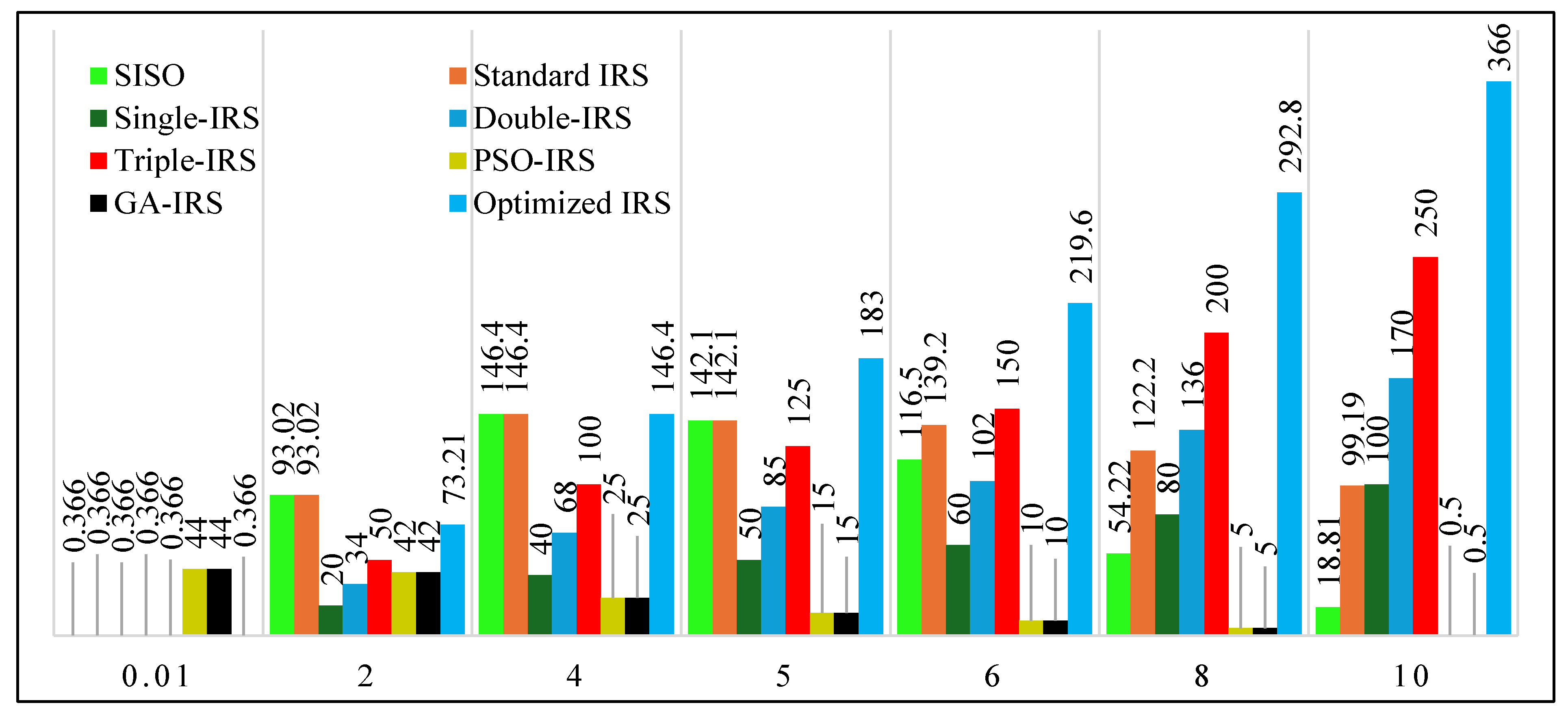
Low Data Rate Regime (
≤ 0.01 bit/s/Hz): At extremely low data rates, all models (SISO, standard IRS, proposed
Moderate Data Rate (2 ≤
≤ 6-bit/s/Hz): The standard IRS matches SISO performance up to
High Data Rate (
≥ 8-bit/s/Hz): The proposed
To measure how much better the ( ) model is than other methods, we use Table 4 to find the percentage increase in Energy Efficiency (EE) at different data rates. Here is a summary of the results:
vs. SISO: At
The
is the same as the standard IRS at low
vs. (Single/Double/Triple-IRS [39]): The
When comparing
to PSO-IRS and GA-IRS [40], the PSO-IRS and GA-IRS models work very well at very low
This analysis and comparison in Table 5 make it easy to see how much better the proposed ( ) model is than earlier studies, showing how useful it could be for future 6G communication systems.
Overall superiority summary percentage improvement of optimized IRS ( ) in this study over other models.
| Comparison | Best Improvement (%) | Worst Case (%) |
|---|---|---|
| Optimized IRS ( ) in this study vs. SISO in this study | +1846% ( = 10) | −21.3% ( = 2) |
| Optimized IRS ( ) in this study vs. Standard IRS in this study | +269% ( = 10) | −21.3% ( = 2) |
| Optimized IRS ( ) in this study vs. (Single-IRS [39]) | +266% (all ≥ 2) | – |
| Optimized IRS ( ) in this study vs. (Triple-IRS [39]) | +46.4% (all ≥ 2) | – |
| Optimized IRS ( ) in this study vs. (PSO-IRS and GA-IRS [40]) | >+485% ( = 4) | −99.2% ( = 0.01) |
When comparing the proposed (
) model to existing models from previous studies in terms of energy efficiency and data rate, it is clear that the (
The simulation results in this study utilize the 3GPP Urban Micro (UMi) channel model, providing a standardized and theoretically robust framework for comparative analysis. However, it is important to remember that the proposed model is useful, but it makes some simplifications and may not fully capture the complexities of real-world radio propagation environments, such as spatial correlations, severe scattering, and changing interference patterns. Therefore, future research must prioritize validation in more intricate and realistic scenarios in order to further strengthen the practical relevance of our findings.
In order to contextualize the simulation results within actual 6G deployment scenarios, this section addresses the practical implementation challenges and limitations of the proposed AI-optimized IRS model, such as channel estimation, hardware imperfections, and scalability. 4.1. Channel Model Assumptions and Dynamic Environments For the sake of tractability, our analysis uses deterministic flat-fading channels to obtain closed-form expressions for data rate and energy efficiency, which is a common strategy in the foundational IRS literature [19,21]. We acknowledge that time-varying fading, shadowing, and blockages are characteristics of real-world environments. Accurate Channel State Information (CSI), which is essential to an IRS’s operation, is difficult to obtain in situations involving mobile users that are changing quickly. Channel estimation is made more difficult by IRS elements’ passive nature, which prevents them from sending or receiving pilot signals [16, 23]. To assess the robustness of the DS-PSO algorithm in uncertain environments, future studies must incorporate stochastic channel models (like Rayleigh or Rician fading) and sophisticated channel estimation techniques. The dynamic topology part of the algorithm, designed for exploration, may be very helpful in adapting to changing environments. Channel Estimation Overhead: It is very difficult to obtain the CSI for the IRS-destination and source-IRS links, particularly when there are many Nᵒ elements. The costs of this estimate must be included in a complete system model. Dynamic Settings: The proposed model operates on static channels. Since moving objects, such as cars and people, can alter channel conditions rapidly, robust and low-latency optimization algorithms are required to adapt to these changes. 4.2. Hardware Imperfections Perfect IRS elements with continuous phase shifts and perfect reflection efficiency (α = 1) are assumed in our model. Hardware is not perfect in real life. Phase shifters frequently undergo quantization (e.g., 1–2 bits), which leads to quantization errors that reduce the beamforming gain. Furthermore, the overall performance of the system may be impacted by amplitude variations, mutual coupling between adjacent elements, and the phase-shifting circuitry’s non-linear power consumption (
). In these less-than-ideal circumstances, the reported energy efficiency gains would need to be reassessed. An important next step is to incorporate these impairments into the optimization problem. Theory and practice perform differently as a result of these flaws, which hinder the ideal phase shift predicted by equations (3) and (7). 4.3. Scalability and Network Integration For 6G systems, the model that is being presented takes into account a single IRS helping a single user. It is critical for scalability to multi-cell, multi-user, and multi-IRS scenarios. When you use more than one IRS, you run into problems like interference between surfaces, collaborative beamforming, and a combinatorial increase in the difficulty of optimization. We would need to use distributed or hierarchical optimization methods to make our current DS-PSO framework work with this level of complexity. Moreover, incorporating IRS control into current network protocols and standards (e.g., for handover and resource allocation) presents a systems-level challenge that must be resolved for seamless implementation. 4.4. Computational Complexity and Real-Time Operation The DS-PSO algorithm is powerful, but it takes more time to compute than analytical solutions. It can only work in real time if the channel’s coherence time is long enough. For places where the signal fades slowly, the optimization can be done offline or with a slow refresh rate. We are actively working on developing low-complexity deep learning-based approximations of the optimization process that would work in high-mobility situations and make sure that the system responds in real time. 4.5. Environmental Obstacles and Deployment It is very important to put IRSs in the right places, as our simulation setup (Figure 2) shows. Unforeseen barriers can sever the presumed Line-of-Sight (LOS) connections to the IRS. For practical use, careful planning for each site and the use of multiple distributed IRSs are needed to make sure that coverage is strong. The proposed model sets a limit on how well the system can work, but real gains will depend on careful deployment strategies that make it more likely that the LOS components will be strong. 4.6. Practical Constraints on Optimal LOS Gains As rightly highlighted, the core of our optimized model relies on achieving the improved LOS channel gains (
and Placement and Obstructions: To get these best results, the IRS must be placed where there are no obstructions and where it can see both the source and the destination clearly. Finding the perfect spot in real-life situations, like urban canyons or crowded indoor spaces, is very hard. The assumed LOS paths can be readily broken by the presence of structures, vegetation, or even moving objects like cars, which would return the channel to a weaker NLOS state and significantly reduce the IRS’s benefit. Site-Specific Planning: It takes extensive, site-specific radio planning to achieve βᵒ practically; it is not just a matter of geometry. Beyond the static, idealized assumptions of our model, intelligent and possibly adaptive deployment strategies are required to account for factors like material reflectivity, incidence angles, and the dynamic presence of new obstacles. These limitations establish the crucial boundary conditions for reaching our anticipated performance rather than invalidating our findings. The authors emphasize that the theoretical gains are only a maximum and that their actualization depends on resolving these deployment issues by combining dynamic channel acquisition, robust beamforming, and IRS placement optimization. As a result, we completely concur that these real-world issues are important and serve as the foundation for current IRS research. Our work establishes a theoretically optimized performance target under controlled conditions, which is an important first step. The notable improvements shown (such as 366 Mbit/Joule at 10-bit/s/Hz) warrant more research into resolving these real-world issues. Building directly upon the solid foundation established by this paper, the next stage of our research will specifically concentrate on integrating robust optimization under imperfect CSI, hardware constraints, and multiuser scalability.
5.1. Conclusions This study tackled the crucial problem of increasing energy efficiency (EE) in IRS-assisted 6G networks under high data rate circumstances by utilizing artificial intelligence (AI). To solve the non-convex optimization problem that comes with designing IRS phase shifts, we used an artificial intelligence (AI) framework as the main part of our method. We created and used a new hybrid Dynamic and Static Particle Swarm Optimization (DS-PSO) algorithm to smartly set up the IRS elements. The results from this AI-driven method show that our improved Intelligent Reflecting Surfaces (IRS) model is much better than standard IRS and SISO systems. At a data rate of 10 bits/s/Hz, it is up to 269% more energy efficient.
is 46.4% better than Triple-IRS, which shows that optimization is better than hardware redundancy. Also, 5.2. Future Work In the future, we will verify the results and test the algorithm’s performance in more challenging environments, such as urban canyons with significant interference and non-line-of-sight (NLOS) components, using measured channel data from real-world scenarios. The encouraging outcomes of our (DS-PSO-
) model provide a solid basis for a number of important research directions. The transition from theoretical models to reliable, workable implementations for 6G systems will be the main focus of our immediate future work, which will be structured along four main lines. First, by substituting sophisticated stochastic models that take into consideration time-varying fading, shadowing, and random blockages for deterministic channels, we intend to expand our model to dynamic and complex environments. We will look into sophisticated Deep Reinforcement Learning (DRL) algorithms to handle this added complexity and allow for real-time adaptation. In the face of erratic interference and user mobility, these agents will be built to continuously learn and optimize IRS configurations. The scalable integration of several IRSs in heterogeneous networks is the second thing we intend to look into. In order to develop "smart radio environments" for the entire network, this research will examine cooperative beamforming between surfaces and inter-IRS interference management. Additionally, we will look into how IRSs and Mobile Edge Computing (MEC) can work together to improve communication and computational energy efficiency by establishing advantageous connections for computational offloading. Third, we will address practical hardware limitations and conduct experimental validation to close the gap between simulation and real-world implementation. Creating methods to reduce amplitude losses and phase quantization errors in metasurfaces will be part of this. The ultimate objective is to validate the anticipated energy efficiency and data rate gains under real-world conditions by designing a prototype and carrying out field trials in a controlled testbed. Finally, the application of this work to MIMO systems is a logical and significant extension. In this case, the optimization problem gets a lot bigger because it has to do with both the active precoding/combining matrices at the transceivers and the passive phase shifts at the IRS. This makes it a coupled, high-dimensional, non-convex problem. We will investigate modifying the DS-PSO algorithm to encode a larger solution vector that encompasses all optimization variables, leveraging its exploratory capabilities to maximize the overall spectral or energy efficiency of the MIMO-IRS system. Concurrently, we will explore the application of more complex AI architectures, particularly DRL, to manage this joint active and passive beamforming optimization with lower latency, assessing its practical robustness against measured channel data from real-world scenarios.
AI
Artificial Intelligence
CSI
Channel State Information
DS-PSO
Dynamic and Static Particle Swarm Optimization
EE
Energy Efficiency
IRS
Intelligent Reflecting Surface
LOS
Line of Sight
MIMO
Multiple-Input Multiple-Output
NLOS
Non-Line-of-Sight
PSO
Particle Swarm Optimization
RIS
Reconfigurable Intelligent Surface
SE
Spectral Efficiency
SISO
Single-Input Single-Output
SNR
Signal-to-Noise Ratio
UMi
Urban Micro (cell)
6G
Sixth-Generation
Conceptualization, methodology, software: J.K.S.A.-S.; validation, formal analysis: A.T.R.A.; investigation, resources, data curation, design and creation of figures, writing—original draft preparation, writing—review and editing, visualization, supervision, project administration: J.K.S.A.-S. and A.T.R.A. All authors have read and agreed to the published version of the manuscript.
All data supporting the findings of this study are included within the manuscript.
No consent for publication is required, as the manuscript does not involve any individual personal data, images, videos, or other materials that would necessitate consent.
The authors declare no conflicts of interest.
The study did not receive any external funding and was conducted using only institutional resources.
The authors would like to thank and acknowledge the use of MATLAB and Microsoft Office for simulations, figures, tables, and complete text preparation.
[1] X. Wang, J. Li, J. Wu, L. Guo, and Z. Ning, “Energy Efficiency Optimization of IRS and UAV-Assisted Wireless Powered Edge Networks,” IEEE J. Sel. Topics Signal Process., vol. 18, no. 7, pp. 1297–1310, 2024. [CrossRef]
[2] J. Li, Y. Huang, J. Wu, X. Wang, and Z. Ning, “Energy Efficiency Maximization for STAR-RIS and UAV-Assisted IUA: A Multi-Agent DRL Approach,” IEEE Internet Things J., vol. 12, no. 21, pp. 43936–43948, 2024. [CrossRef]
[3] J. Wang and S. Chen, “Deep Reinforcement Learning-Based Secrecy Rate Optimization for Simultaneously Transmitting and Reflecting Reconfigurable Intelligent Surface-Assisted Unmanned Aerial Vehicle-Integrated Sensing and Communication Systems,” Sensors, vol. 25, no. 5, p. 1541, 2025. [CrossRef]
[4] P. Vishwakarma, S. N. Sur, S. Dhar, and D. Bhattacharjee, “IRS-Assisted SWIPT: Power Optimization Strategies for Green Communications,” in presented at the 2025 17th International Conference on COMmunication Systems and NETworks (COMSNETS), Bengaluru, India, 6–10 Jan. 2025, pp. 356–364. [CrossRef]
[5] H. Sadia, H. Iqbal, and S. Qadir, “Physical Layer Security in Intelligent Reflecting Surface-Enabled Small NOMA IoT Network,” in presented at the 2024 11th International Conference on Wireless Networks and Mobile Communications (WINCOM), Leeds, UK, 23–25 July 2024, pp. 1–6. [CrossRef]
[6] Q. Wu, T. Lin, X. Yu, Y. Zhu, and R. Schober, “Beamforming for PIN Diode-Based IRS-Assisted Systems Under a Phase Shift-Dependent Power Consumption Model,” IEEE Trans. Commun., vol. 73, no. 9, pp. 8092–8109, 2025. [CrossRef]
[7] W. Fang, W. Chen, Q. Wu, X. Zhu, Q. Wu, and N. Cheng, “Channel Characterization of IRS-Assisted Resonant Beam Communication Systems,” IEEE Trans. Commun., vol. 73, no. 9, pp. 7381–7397, 2025. [CrossRef]
[8] P. Siddhartha, L. Yashvanth, and C. R. Murthy, “Exploiting Beam-Split in IRS-Aided Systems via OFDMA,” in presented at the ICASSP 2025-2025 IEEE International Conference on Acoustics, Speech and Signal Processing (ICASSP), Hyderabad, India, 6–11 Apr. 2025, pp. 1–5. [CrossRef]
[9] Y. Chen, Q. Wu, G. Chen, and W. Chen, “Spatial Multiplexing Oriented Channel Reconfiguration in Multi-IRS Aided MIMO Systems,” IEEE Trans. Veh. Technol., vol. 74, no. 6, pp. 9840–9845, 2025. [CrossRef]
[10] M. Maashi, et al., “Energy Efficiency Optimization for 6G Multi-IRS Multi-Cell NOMA Vehicle-to-Infrastructure Communication Networks,” Comput. Commun., vol. 225, pp. 350–360, 2024. [CrossRef]
[11] J. Zhao, Q. Zhang, T. Ai, X. Wei, and F. Peng, “Optimal Reconfigurable Intelligent Surface Deployment for Secure Communication in Cell-Free Massive Multiple-Input Multiple-Output Systems with Coverage Area,” Electronics, vol. 14, no. 2, p. 241, 2025. [CrossRef]
[12] S. Sivasankar and S. Markkandan, “Fast and Scalable Intelligent Reflecting Surface Beamforming Using Hybrid Learning Approaches,” IEEE Access, vol. 13, pp. 152826–152842, 2025. [CrossRef]
[13] M. A. Ahmed, A. Baz, and M. M. Fouda, “Polyhedron Optimization for Power Allocation of Cell-Free Based IRS System,” IEEE Access, vol. 12, pp. 76065–76073, 2024. [CrossRef]
[14] A. Khaled, A. S. Alwakeel, A. M. Shaheen, M. M. Fouda, and M. I. Ismail, “Placement Optimization and Power Management in a Multiuser Wireless Communication System with Reconfigurable Intelligent Surfaces,” IEEE Open J. Commun. Soc., vol. 5, pp. 4186–4206, 2024. [CrossRef]
[15] K. Wang, P. Liu, K. Liu, L. Chen, H. Shin, and T. Q. S. Quek, “Joint Beamforming and Phase-Shifting Design for Energy Efficiency in RIS-Assisted MISO Communication with Statistical CSI,” Phys. Commun., vol. 59, p. 102080, 2023. [CrossRef]
[16] H. Hashida, Y. Kawamoto, and N. Kato, “Mathematical Modeling and Deployment Optimization: Intelligent Reflecting Surface-Aided Communications Under Partial Blockages,” IEEE Trans. Cogn. Commun. Netw., vol. 11, no. 5, pp. 3306–3316, 2025. [CrossRef]
[17] G. D. Verma, A. Mathur, Y. Ai, and M. Cheffena, “Mixed Dual-Hop IRS-Assisted FSO-RF Communication System with H-ARQ Protocols,” IEEE Commun. Lett., vol. 26, no. 2, pp. 384–388, 2021. [CrossRef]
[18] A. Sikri, A. Mathur, and G. Kaddoum, “Joint Impact of Phase Error, Transceiver Hardware Impairments, and Mobile Interferers on RIS-Aided Wireless System Over κ-μ Fading Channels,” IEEE Commun. Lett., vol. 26, no. 10, pp. 2312–2316, 2022. [CrossRef]
[19] C. Lai and R. Zhao, “An Autocorrelation-Based r-Stability Condition With Application in the Design of IIR Filters,” IEEE Signal Process. Lett., vol. 31, pp. 1389–1393, 2024. [CrossRef]
[20] J. Li, J. Liu, and J. Wang, “Optimizing Spectrum and Energy Efficiency in IRS-Enabled UAV-Ground Communications,” Comput. Netw. Jan., vol. 256, p. 110911, 2025. [CrossRef]
[21] A. T. Alsahlanee, “Convergence Rate For Low-Pass Infinite Impulse Response Digital Filter,” J. Phys. Conf. Ser. Jul., vol. 1963, no. 1, p. 012103, 2021. [CrossRef]
[22] A. T. R. Alsahlanee and J. K. S. Al-Safi, “Improving Channel Gain of 6G Communications Systems Supported by Intelligent Reflective Surface,” Indones. J. Elect. Eng. Inform. (IJEEI), vol. 13, no. 1, pp. 57–68, Feb. 2025. [CrossRef]
[23] J. Singh, N. A. Shelke, D. S. Hasan, M. Sajid, A. T. R. Alsahlanee, and K. Upreti, “Enhanced Learning in IoT-Based Intelligent Plant Irrigation System for Optimal Growth and Water Management,” in presented at the International Conference on Intelligent Systems Design and Applications, Olten, Switzerland, 11–13 Dec. 2023, pp. 231–240. [CrossRef]
[24] J. K. S. Al-Safi and C. Kaleli, “A Correlation and Slope-Based Neighbor Selection Model for Recommender Systems,” in presented at the Next Generation of Internet of Things: Proceedings of ICNGIoT 2021, Odisha, India, 5–6 Febr. 2021, pp. 243–268. [CrossRef]
[25] J. Al-Safi and C. Kaleli, “Item Genre-Based Users Similarity Measure for Recommender Systems,” Appl. Sci., vol. 11, no. 13, p. 6108, 2021. [CrossRef]
[26] P. K. Keer, J. K. S. Al-Safi, S. B. G. T. Babu, and G. Ramesh, “Artificial Intelligence in Computer Network Technology in The Big Data Era,” in presented at the 2022 5th International Conference on Contemporary Computing and Informatics (IC3I), Uttar Pradesh, India, 14–16 Dec. 2022, pp. 2131–2135. Available: https://alochana.org/wp-content/uploads/50-AJ3257.pdf
[27] E. Björnson, Ö. Özdogan, and E. G. Larsson, “Intelligent Reflecting Surface Versus Decode-and-Forward: How Large Surfaces Are Needed to Beat Relaying?,” IEEE Wireless Commun. Lett., vol. 9, no. 2, pp. 244–248, 2019. [CrossRef]
[28] Ö. Özdogan, E. Björnson, and E. G. Larsson, “Intelligent Reflecting Surfaces: Physics, Propagation, and Pathloss Modeling,” IEEE Wireless Commun. Lett., vol. 9, no. 5, pp. 581–585, 2019. [CrossRef]
[29] Q. Wu and R. Zhang, “Intelligent Reflecting Surface Enhanced Wireless Network via Joint Active and Passive Beamforming,” IEEE Trans. Wireless Commun., vol. 18, no. 11, pp. 5394–5409, 2019. [CrossRef]
[30] J. Wang, H. Yang, Z. Wang, and C. Li, “MDRD-Based Channel State Information Acquisition Scheme for Intelligent Reflecting Surface-Aided Wireless Communication Systems,” Phys. Commun., vol. 71, p. 102667, 2025. [CrossRef]
[31] Z. Q. He and X. Yuan, “Cascaded Channel Estimation for Large Intelligent Metasurface Assisted Massive MIMO,” IEEE Wireless Commun. Lett., vol. 9, no. 2, pp. 210–214, 2019. [CrossRef]
[32] D. Tyrovolas, et al., “Energy-Aware Trajectory Optimization for UAV-Mounted RIS and Full-Duplex Relay,” IEEE Internet Things J., vol. 11, no. 3, pp. 24259–24272, 2024. [CrossRef]
[33] C. Y. Goh, C. Y. Leow, and R. Nordin, “Energy Efficiency of Unmanned Aerial Vehicle with Reconfigurable Intelligent Surfaces: A Comparative Study,” Drones, vol. 7, no. 2, pp. 1–17, 2023. [CrossRef]
[34] E. Björnson and L. Sanguinetti, “Demystifying the Power Scaling Law of Intelligent Reflecting Surfaces and Metasurfaces,” in presented at the 2019 IEEE 8th International Workshop on Computational Advances in Multi-Sensor Adaptive Processing (CAMSAP), Le Gosier, Guadeloupe, 15–18 Dec. 2019, pp. 549–553. [CrossRef]
[35] D. Bratton and J. Kennedy, “Defining a Standard for Particle Swarm Optimization,” in presented at the 2007 IEEE Swarm Intelligence Symposium, SIS 2007, Honolulu, HI, USA, 1–5 Apr. 2007, pp. 120–127. [CrossRef]
[36] J. Kennedy and R. Eberhart, “Particle Swarm Optimization,” in presented at the ICNN’95-International Conference on Neural Networks, Perth, WA, Australia, 27 Nov.–1 Dec. 1995, pp. 1942–1948. [CrossRef]
[37] D. Sanchez, “DS-PSO: Particle Swarm Optimization with Dynamic and Static Topologies. Bowdoin College, Bowdoin Digital Commons, Honors Projects, 2017,”. [Online]. Available: https://digitalcollections.bowdoin.edu/view/5093 (Accessed: 1 May 2017)..
[38] GPP, “Further Advancements for E-UTRA Physical Layer Aspects (Release 9). 3rd Generation Partnership Project (3GPP), Technical Report 36.814, 2010,”. [Online]. Available: https://api.semanticscholar.org/CorpusID:16652630 (Accessed: 1 Nov. 2025)..
[39] S. Penchala, S. K. Bandari, V. V. Mani, and A. Drosopoulos, “Controlled Wireless Channel using Multi-Antenna Multi-IRS Assisted Communication System: A Comprehensive Performance Analysis,” IEEE Latin America Trans., vol. 23, no. 2, pp. 114–124, 2025. [CrossRef]
[40] H. Nguyen-Thi, T. Kieu-Xuan, T. Le-Nhat, and A. Le-Thi, “Improving Energy Efficiency for Intelligent Reflecting Surface Assisted PD-NOMA in EH Relaying Network,” J. Inf. Telecommun., pp. 1–24, 2025. [CrossRef]
Disclaimer/Publisher’s Note: The views expressed in this article are those of the author(s) and do not necessarily reflect the views of the publisher or editors. The publisher and editors assume no responsibility for any injury or damage resulting from the use of information contained herein.
© 2025 Copyright by the Authors.