

 ACCESS
Research Article
ACCESS
Research Article
Volume 2, Article ID: 2026.0028

Onyekachi Stephen Nnamani
nonyekachi865@gmail.com

Benson Chinweuba Udeh
bc_udeh@yahoo.com

Cyprian Obinna Azinta
azinta.acom@gmail.com

Department of Chemical Engineering, Enugu State University of Science and Technology, Enugu, Nigeria
* Author to whom correspondence should be addressed
Received: 15 Apr 2026 Available Online: 08 Jul 2026
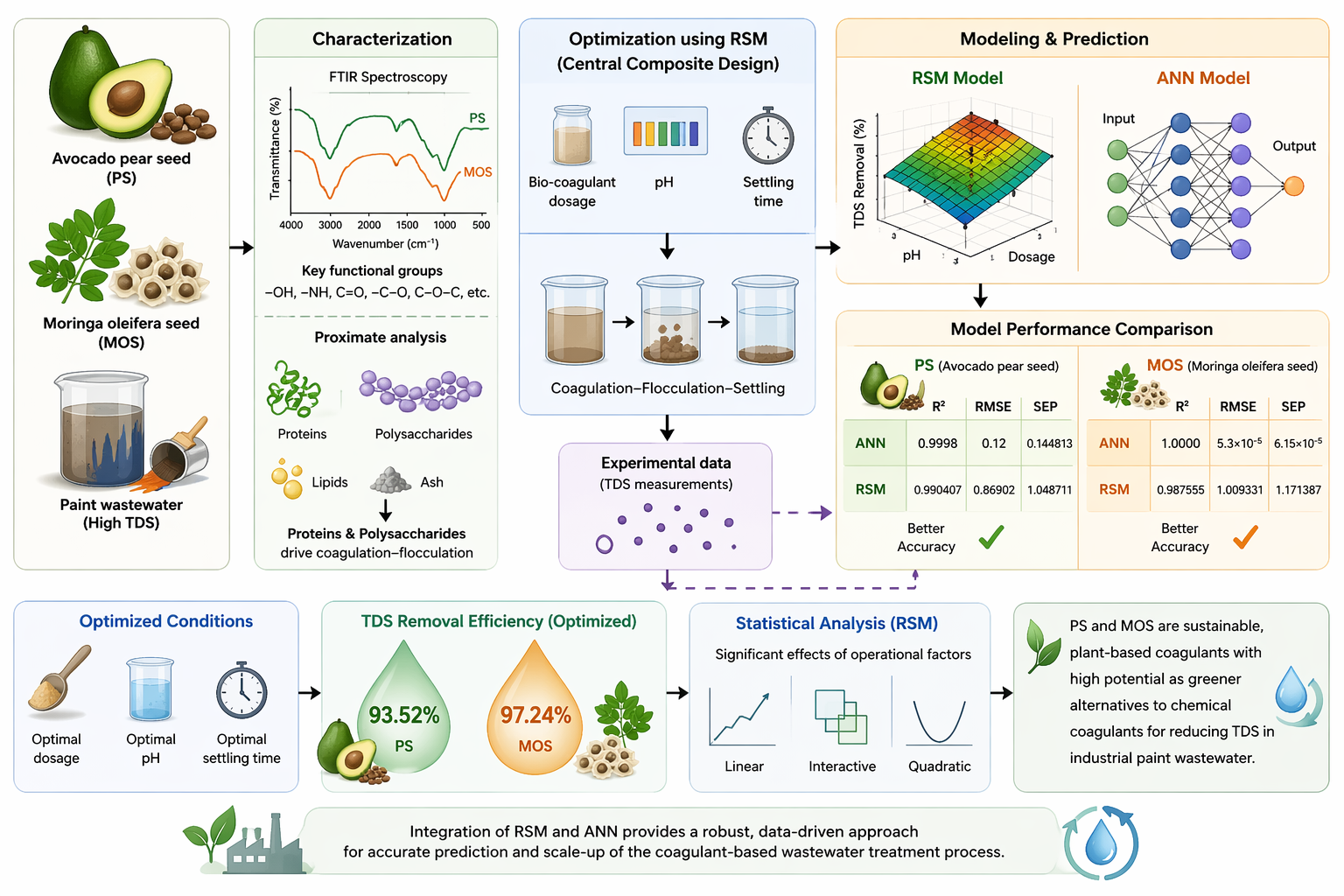
The efficiency of total dissolved solids (TDS) removal from paint wastewater (PWW) was investigated and optimized in this work. Sustainable natural coagulants made from avocado pear seed (PS) and moringa oleifera seed (MOS) were used for TDS reduction in PWW. Fourier Transform Infrared spectroscopy and proximate analysis were used to characterize the materials. The results obtained showed the presence of major functional groups, proteins and polysaccharides known to facilitate the coagulation-flocculation process. The optimum operating conditions for maximizing different parameters such as bio-coagulant dosage, pH and settling time were established by response surface methodology (RSM) with central composite design. Furthermore, an Artificial Neural Network (ANN) model was developed based on the same experimental data to better decipher complex, nonlinear relationships between variables. The ANN model was found to give a better prediction accuracy than RSM based on statistical indicators such as R², RMSE and SEP for both types of bio-coagulants. For PS, ANN achieved R² = 0.9998, RMSE = 0.12, and SEP = 0.144813, compared to RSM values of R² = 0.990407, RMSE = 0.86902, and SEP = 1.048711. For MOS, ANN attained R² = 1.0000, RMSE = 5.3×10⁻⁵, and SEP = 6.15×10⁻⁵, exceeding RSM performance with R² = 0.987555, RMSE = 1.009331, SEP = 1.171387. Optimized conditions resulted in TDS removal efficiencies of 93.52% and 97.24% for PS and MOS respectively. The statistical analysis showed significant linear, interactive and quadratic effects of operational factors. Both PS and MOS presented significant promise as greener alternatives to conventional chemical coagulants. The combination of RSM and ANN models provided a reliable data driven framework for the prediction of TDS removal performance and optimization of operating conditions.
Disclaimer: This is not the final version of the article. Changes may occur when the manuscript