

 ACCESS
Review Article
ACCESS
Review Article
Volume 1, Article ID: 2026.0004

Nada M. Elfeky
nada.elfeky96@gmail.com

Merna G. Khalaf
merna.20135809@pharm.aun.edu.eg

Noha G. Morsi
Nohagamal44@gmail.com

Heba A. Fathi
HebaA.Fathi@Pha.nvu.edu.eg

Safy Hadiya
Safyhadeya@aun.edu.eg

Omnia H.M. Omar
omnia.hossam.eldin@pharm.aun.edu.eg

Gihan Fetih
gfetih@aun.edu.eg

Sherif I. Kamel
shereef_kamel@aun.edu.eg

Mahmoud Elbadry
elbadry@aun.edu.eg

1 Assiut International Center of Nanomedicine, Al-Rajhy Liver Hospital, Assiut University, Assiut 71515, Egypt
2 Department of Pharmaceutics, Faculty of Pharmacy, New Valley University, Al-Wadi Al-Gadid, Al-Kharga 72511, Egypt
3 Department of Pharmaceutics, Faculty of Pharmacy, Assiut University, Assiut 71515, Egypt
4 Department of Tropical Medicine and Gastroenterology, Faculty of Medicine, Assiut University, Assiut 71515, Egypt
* Author to whom correspondence should be addressed
† These authors contributed equally.
Received: 18 Mar 2026 Accepted: 15 Jun 2026 Available Online: 15 Jun 2026
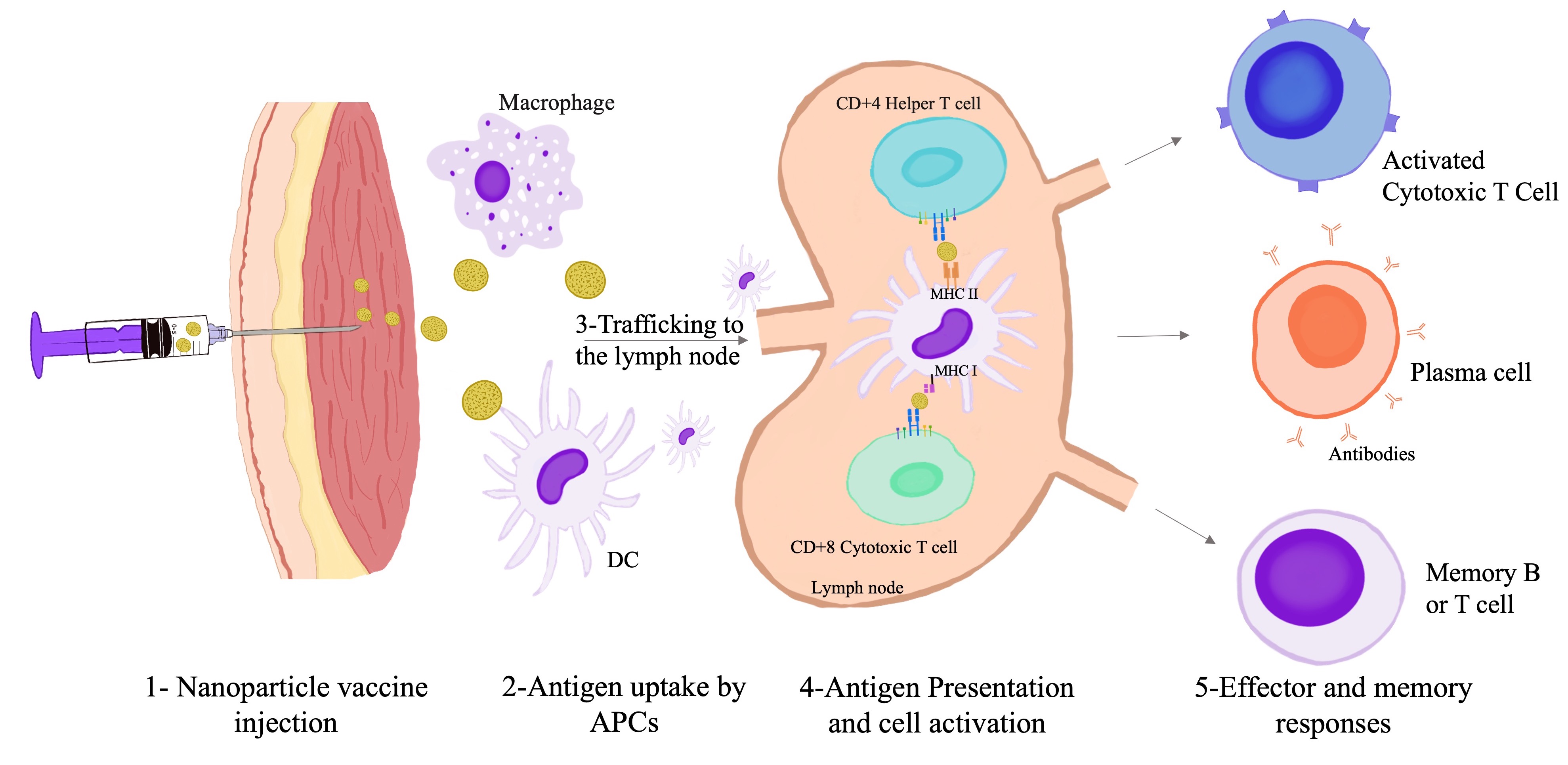
Vaccines are one of the most notable developments in modern medicine, and their role in combating and even eradicating diseases cannot be overlooked. Through an immunological cascade, vaccines produce an immunological memory response evident by memory cells and antibodies formation. Ever since the introduction of the first vaccine against smallpox, great efforts have been made to further improve vaccine efficacy, overcome limitations, and develop vaccines against emerging pathogens. The utilization of nanotechnology in vaccines has many benefits, as nanotechnology can address most of the limitations of traditional vaccines. Moreover, it has paved the path for the development of several vaccinations and is expected to continue contributing to future advancements. Nanoparticles have several types, with each type having its advantages and drawbacks. The physicochemical characteristics of these nanoparticles, namely particle size, particle shape, particle rigidity, surface charge, and hydrophobicity, affect the immune response potency. Optimization of these properties can allow the manufacture of vaccines that trigger strong immune responses. This strategic optimization permitted the production of effective vaccine formulations against several major pathogens in the market. Notable nanoparticle vaccines include the human papillomavirus, malaria, hepatitis B, and severe acute respiratory syndrome coronavirus 2 vaccines. This comprehensive review explores the vaccine immunological cascade, the platforms of nanoparticles, their advantages and drawbacks, and the impact of their physicochemical characteristics on vaccine efficacy. Moreover, this review highlights the nanovaccine formulations that have been approved for use.
Disclaimer: This is not the final version of the article. Changes may occur when the manuscript is published in its final format.