


 ACCESS
Research Article
ACCESS
Research Article
Volume 2, Article ID: 2026.0011

Abraham Olasupo Oladebeye
aooladebeye@unimed.edu.ng

Aderonke Adenike Oladebeye
oladebeyea@auchipoly.edu.ng

1 Department of Science Laboratory Technology, University of Medical Sciences, Ondo, Nigeria
2 Department of Food Technology, Auchi Polytechnic, Auchi, Nigeria
* Author to whom correspondence should be addressed
Received: 23 Dec 2025 Accepted: 14 May 2026 Available Online: 15 May 2026
Abstract
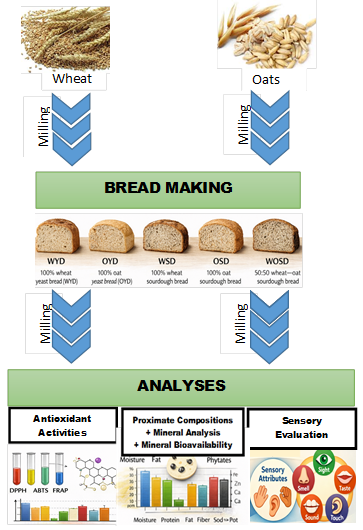
Sourdough breads produced from wheat and oat flours were evaluated for proximate compositions, mineral profiles, estimated mineral bioavailability, antioxidant activities, and sensory quality, with yeast-leavened breads used as controls. Five bread samples were prepared: 100% wheat yeast dough bread (WYD), 100% oat yeast dough bread (OYD), 100% wheat sourdough bread (WSD), 100% oat sourdough bread (OSD), and a 50:50 wheat–oat sourdough bread (WOSD). The bread samples exhibited moisture (23.54±0.36–32.38±0.09%), ash (0.80±0.01–1.32±0.12%), fat (8.55±0.50–18.11±0.67%) contents, crude protein (7.34±0.10–11.66±0.12%), crude fibre (0.18±0.00–1.04±0.04%), and carbohydrate by difference (40.21±0.70–55.27±0.97%). Sodium (31.19±0.01–41.21±0.00 ppm) and potassium (38.09±0.01–44.21±0.00 ppm) were the predominant minerals, with sourdough breads maintaining comparable mineral levels to yeast-leavened breads (p < 0.05). Phytate contents ranged from 8.15 to 12.10 mg/g, with WOSD exhibiting the lowest phytate level and more favourable phytate-to-mineral molar ratios, indicating improved relative mineral bioavailability. Antioxidant assays demonstrated significantly higher DPPH radical scavenging activity, ABTS activity, and FRAP in sourdough breads than yeast controls, with WOSD showing the peak antioxidant activity. Sensory evaluation indicated that wheat yeast bread was most preferred in terms of colour and appearance, while sourdough breads were rated higher for flavour and aroma, with overall acceptability scores ranging from 7.60±0.52to 8.90±0.32on a nine-point hedonic scale. These data indicated that the combination of improved antioxidant activity and acceptable sensory quality of WOSD unveiled its potential as a nutritionally enriched bakery food product.
Disclaimer: This is not the final version of the article. Changes may occur when the manuscript is published in its final format.