

 ACCESS
Review Article
ACCESS
Review Article
Volume 3, Article ID: 2026.0027

Ke Li
cocos1n@163.com

Yu Liu
yuliu23@connect.hku.hk


Guangzhao Huang
1294329270@qq.com

Ruohan Zhai
zly200202@163.com

Chunjie Li
lichunjie@scu.edu.cn

1 State Key Laboratory of Oral Diseases & National Center for Stomatology & National Clinical Research Center for Oral Diseases & Department of Head and Neck Oncology, West China Hospital of Stomatology, Sichuan University, Chengdu 610041, Sichuan, China.
2 Faculty of Dentistry, The University of Hong Kong, Hong Kong.
3 State Key Laboratory of Oral Diseases & National Clinical Research Center for Oral Diseases & Department of Cariology and Endodontics, West China Hospital of Stomatology, Sichuan University, Chengdu 610041, Sichuan, China.
* Author to whom correspondence should be addressed
Received: 11 Oct 2025 Accepted: 09 Jun 2026 Available Online: 10 Jun 2026
This article is part of the Special Issue Spatial Omics in Cancer: Decoding Heterogeneity, Microenvironment Crosstalk, and Therapeutic Implications
Cancer is a serious health problem worldwide. The treatment resistance and variability in clinical outcomes are both challenges for oncology. The tumor microenvironment (TME) plays a significant role in tumor development, treatment response, and spatial heterogeneity. These characteristics vary among different cancer types, patients, and tumor regions. Traditional methods in oncology have not been able to deeply understand the complexity of these interactions without considering spatial factors. In recent years, the development of spatial omics has made significant progress. This technology can analyze gene activity, protein expression, and cell communication within tissues at the same time, providing a deeper understanding of the TME.
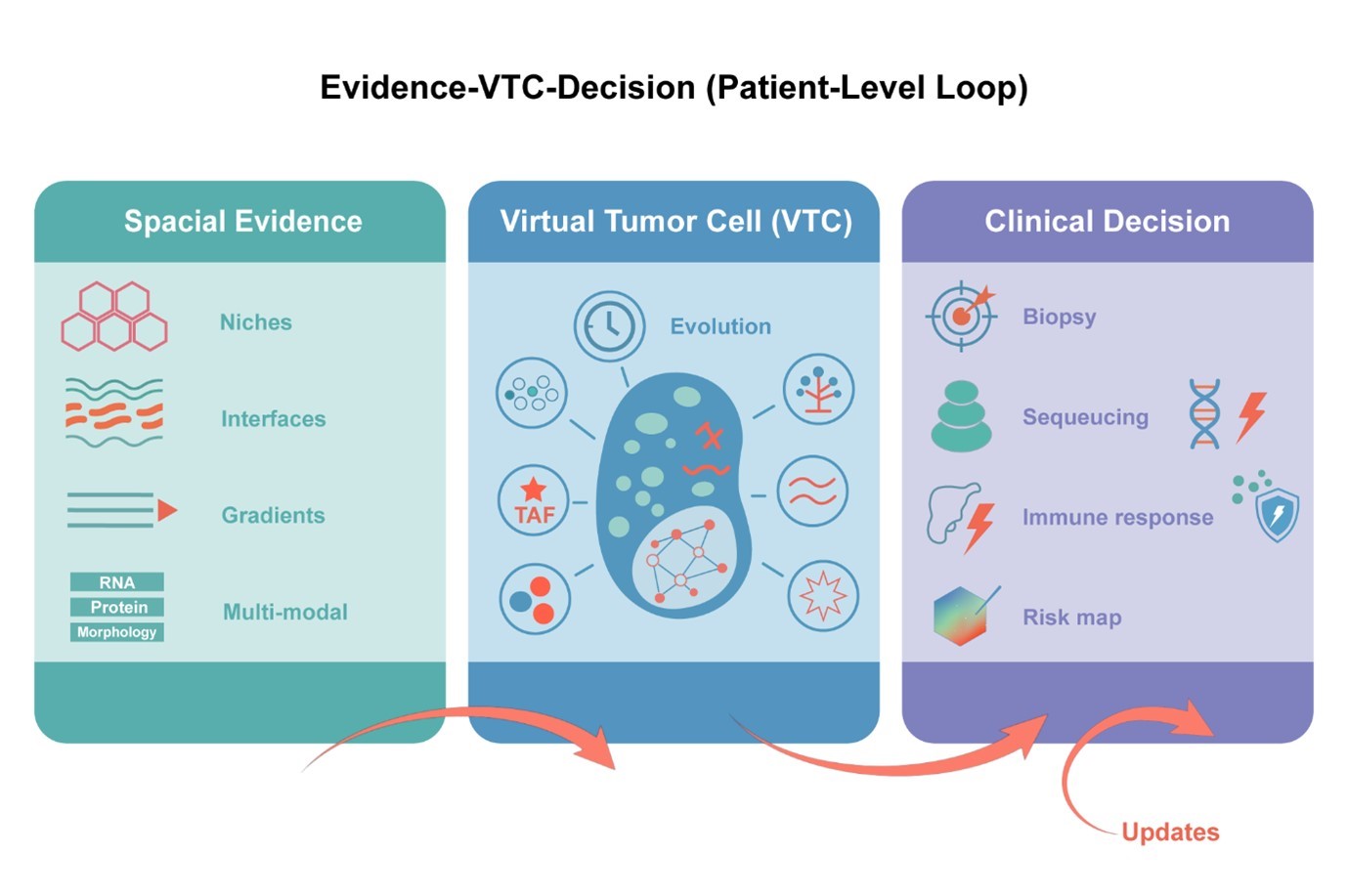
This review explores how spatial omics technologies can help connect molecular profiling with clinical applications. We particularly focus on the concept of a "virtual tumor ecosystem." We discuss how spatial omics data can be integrated with computational models to build dynamic, patient-specific digital simulations. These virtual tumor organs can mimic actual tumor behavior and predict treatment responses. The ability to use a patient's own spatial data to simulate therapies and predict drug resistance represents a significant advance in precision cancer medicine. The virtual tumor ecosystem can link spatial omics data with the treatment outcomes of patients, and is expected to enhance the level of personalized cancer treatment. This review summarizes the latest progress in using spatial omics technology to construct cancer models. We also discuss the main challenges faced by this method and its future development prospects. We are aiming to promote the clinical application of related research results and to develop more effective treatment plans for each patient.
Disclaimer: This is not the final version of the article. Changes may occur when the manuscript is published in its final format.